
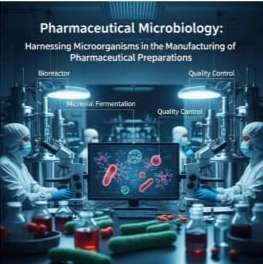
Pharmaceutical Microbiology: Harnessing Microorganisms in the Manufacturing of Pharmaceutical Preparations
M.M. Zeina Haider Abbas
Introduction
Microorganisms represent an immense natural resource that humanity has historically harnessed for various purposes, with the pharmaceutical field being one of the most prominent beneficiaries. Bacteria, fungi, and yeasts are no longer merely disease-causing agents; they have transformed into environmentally friendly biological factories producing essential therapeutic agents indispensable to modern medicine. The concept of pharmaceutical microbiology refers to that specialized branch of pharmaceutical sciences concerned with exploiting microorganisms, whether in their natural form or after genetic engineering, in the production of pharmaceutical preparations and biologically active compounds. This field has witnessed tremendous qualitative leaps due to rapid advancements in genetic engineering techniques and synthetic biology, opening broad horizons for producing more effective and lower-cost medications (Sadanov et al., 2025).
The strategic importance of pharmaceutical microbiology lies in its ability to produce complex pharmaceutical compounds that are impossible or extremely difficult to synthesize chemically, such as therapeutic proteins (e.g., insulin and growth hormone) and antibiotics (e.g., penicillin and vancomycin) (Sadanov et al., 2025).
Main Microorganisms in the Pharmaceutical Industry
The microorganisms proven effective as biological factories in the pharmaceutical industry are numerous, and the selection of an appropriate organism depends on the nature and complexity of the desired product. These organisms are classified into several main groups, each with unique characteristics making them suitable for specific applications.
Bacteria: Factories for Therapeutic Proteins and Antibiotics
Bacteria are among the most widely used microorganisms in pharmaceutical biotechnology. The bacterium Escherichia coli tops the list of bacterial organisms used on a large scale for several reasons, including ease of genetic manipulation, rapid growth, and ability to produce large quantities of recombinant proteins (Sadanov et al., 2025). E. coli is primarily used in producing human insulin, growth hormone, various growth factors, in addition to therapeutic enzymes and antibody fragments (Graham and Awang, 2024). Its success stems from the possibility of introducing plasmids carrying the desired gene into it, transforming it into small factories efficiently producing the therapeutic protein.
On the other hand, bacteria of the genus Streptomyces hold a prominent position in the history of antibiotic discovery. They are responsible for producing more than two-thirds of naturally occurring antibiotics used clinically, including streptomycin, erythromycin, and tetracyclines (Sadanov et al., 2025). Streptomyces are characterized by possessing gene clusters responsible for synthesizing these complex compounds and modifying them post-synthesis. Researchers are currently working on activating these “silent” gene clusters using modern techniques such as CRISPR to discover new antibiotics. Bacteria such as Bacillus subtilis are also used in producing enzymes and vaccines due to their superior ability to secrete proteins into the surrounding medium, facilitating subsequent purification processes (García, 2025).
Fungi and Yeasts: Producing Insulin and Traditional Antibiotics
Fungi played a historical role in ushering in the antibiotic era with the discovery of penicillin from the fungus Penicillium (García, 2025). Filamentous fungi such as Aspergillus species are still widely used in producing antibiotics, organic acids (e.g., citric acid), and enzymes.
As for yeasts, particularly Saccharomyces cerevisiae (baker’s yeast), they represent model organisms in biotechnology. They are characterized by their ability to perform post-translational modifications on proteins, such as glycosylation, a property lacking in E. coli (García, 2025). This makes them suitable for producing complex human proteins requiring such modifications to ensure efficacy. Yeast is also used in producing vaccines such as the recombinant hepatitis B vaccine, in addition to various enzymes and hormones.
Fermentation: The Heart of Biopharmaceutical Industry
Fermentation is the fundamental process in which microorganisms are cultivated under controlled conditions inside bioreactors to produce the desired pharmaceutical compound (Graham and Awang, 2024). The process begins with a high-yielding microbial strain, preserved in Master Cell Banks at very low temperatures to ensure genetic stability and continuity for years (BOC Sciences, 2025). A sample from this bank is taken to produce a Working Cell Bank used in routine production operations.
The fermentation process proceeds through several stages:
Inoculum Development: It begins by culturing a small amount from the working bank in small flasks, then transferring it to gradually larger reactors to reach the necessary biomass for starting the main fermentation (BOC Sciences, 2025).
Large-Scale Fermentation: This occurs in bioreactors made of stainless steel or single-use types, ranging in capacity from hundreds to thousands of liters (Graham and Awang, 2024). Multiple factors inside the reactor must be precisely controlled to ensure optimal growth and high productivity. These factors include temperature, pH, dissolved oxygen concentration, mixing speed, and feeding of the culture medium (Guerra, 2025). The feeding process can be batch, fed-batch, or continuous, each having advantages depending on the nature of the organism and product.
Technical Challenges: Fermentation faces challenges such as the need for high oxygen transfer, dissipation of heat generated by microbial metabolism, and preventing contamination by other organisms. These challenges require careful reactor design, including baffles to improve mixing, internal cooling coils for heat dissipation, and reliable sterilization systems (SIP) (Graham and Awang, 2024).
Genetic Engineering and Synthetic Biology: Designing Specialized Biological Factories
The genetic engineering revolution marked a qualitative leap in pharmaceutical microbiology, enabling scientists to modify microorganisms with unprecedented precision to enhance their productivity and endow them with new traits. The CRISPR-Cas9 system is the most revolutionary tool in this field, allowing precise targeting and cutting of specific genes within the microbial genome (Khazem, El-Gebali and El-Sayed, 2025). This technique can be used to disrupt genes inhibiting biosynthetic pathways or to introduce complete new genes enabling the organism to produce compounds it does not naturally produce.
Applications of genetic engineering in pharmaceutical microbiology include:
Improving Insulin Production: E. coli has been genetically modified using CRISPR to improve the protein expression framework, leading to increased recombinant insulin productivity (Sadanov et al., 2025).
Activating Silent Gene Clusters: Bacteria like Streptomyces possess gene clusters responsible for synthesizing natural compounds, but these are “silent” under normal conditions. Using techniques such as CRISPR interference (CRISPRi) and CRISPR activation (CRISPRa), researchers have activated these clusters and discovered new natural compounds with potential pharmaceutical activity (Yang et al., 2025).
Developing Living Therapeutics: Genetically modified bacteria are currently being developed to act as “living therapeutics” that can colonize the patient’s intestine and continuously secrete therapeutic factors to treat chronic diseases such as inflammations or certain types of cancer (Khazem, El-Gebali and El-Sayed, 2025).
Purification and Quality Control: Ensuring Safety and Efficacy
After the fermentation process concludes, the most difficult and often most expensive part begins: extracting and purifying the pharmaceutical compound from the fermentation medium. The purification method depends on the product’s location. If the product is secreted into the surrounding medium (extracellular), cells are first separated by centrifugation or filtration, then the liquid is purified. If the product is inside the cells (intracellular), the cells must be lysed to release it (Guerra, 2025).
The downstream processing involves several sequential steps:
Filtration and Centrifugation: To separate the biomass from the liquid.
Chromatography: This is the primary technique for product purification. Various types are used (ion exchange chromatography, affinity chromatography, size exclusion chromatography) to isolate the desired compound based on its physicochemical properties (Guerra, 2025).
Ultrafiltration: To concentrate the solution and change the medium surrounding the product.
Crystallization: To obtain the product in a pure solid form.
Quality control represents a fundamental pillar no less important than production itself. All stages of the process must undergo strict supervision according to Good Manufacturing Practices (GMP). This includes:
Sterility Tests: To ensure the final product is free from any microbial contaminants.
Endotoxin Tests: These are particularly necessary for injectable products.
Environmental Monitoring: Of facilities, production lines, air, and used water to prevent any potential source of contamination.
Regulatory and Industrial Challenges
Scale-up: The transition from laboratory-scale production to commercial scale presents a significant challenge. Optimal conditions in a small reactor (5 liters) may not be directly applicable in a large reactor (10,000 liters), necessitating re-optimization of operational conditions (Graham and Awang, 2024).
Regulatory Requirements: Biological products are subject to strict and complex regulatory systems. Manufacturers must demonstrate that the entire production process, from the cell bank to the final product, is consistent, reproducible, and under strict control, requiring comprehensive documentation and significant investments (Guerra, 2025).
Biosafety: Genetically modified organisms raise biosafety concerns, especially those designed for use as living therapeutics. Effective biological containment strategies must be developed, such as genetic “suicide” systems that eliminate the organism if it leaves the target environment, to ensure it does not harm the environment or the patient (Khazem, El-Gebali and El-Sayed, 2025).
Conclusion
Pharmaceutical microbiology confirms the depth of the integrative relationship between microbiology and pharmaceutical sciences, as microorganisms have transformed from mere agents associated with disease into essential partners in the healing process. By employing fermentation and genetic engineering techniques, we have harnessed these organisms to produce a wide range of life-saving drugs, from traditional antibiotics to complex therapeutic proteins and advanced gene therapies. Advances in techniques such as CRISPR and artificial intelligence represent a promising qualitative leap to enhance the efficiency of these biological factories and expand their horizons. However, the greatest challenge remains achieving a balance between innovation and safety by developing flexible regulatory frameworks that ensure maximum benefit from these technologies while minimizing their potential risks. The future looks promising for this vital specialty, heading towards designing smarter and more personalized treatments capable of dynamically interacting with the human body to achieve the highest levels of therapeutic efficacy.
References
BOC Sciences (2025) ‘Scaling up polymyxin and vancomycin production: a fermentation-based approach’, BOC Sciences Blog, 3 December. Available at: https://bio-fermen.bocsci.com/news-blogs/scaling-up-polymyxin-and-vancomycin-production-a-fermentation-based-approach.html (Accessed: 24 February 2026).
García, M. (2025) ‘Which microorganisms are key in the R&D pharmaceutical industry?’, AINIA, 24 November. Available at: https://www.ainia.com/en/ainia-news/which-microorganisms-are-key-in-the-rd-pharmaceutical-industry/ (Accessed: 24 February 2026).
Graham, C. and Awang, G. (2024) ‘High-growth microbial fermentation for the manufacture of biologics’, Pharmaceutical Technology, 21 February. Available at: https://www.pharmtech.com/view/high-growth-microbial-fermentation-for-the-manufacture-of-biologics (Accessed: 24 February 2026).
Guerra, M. (2025) ‘Why microbiology matters in API production’, Suanfarma CDMO. Available at: https://www.suanfarma.com/cdmo/why-microbiology-matters-in-api-production/ (Accessed: 24 February 2026).
Khazem, A., El-Gebali, S. and El-Sayed, M. (2025) ‘Engineered microbial living matter for diagnostics, prevention, and therapy’, Current Opinion in Biotechnology, 93, p. 103269. doi: 10.1016/j.copbio.2025.103269.
Sadanov, A.K., Baimakhanova, B.B., Orasymbet, S.E., Ratnikova, I.A., Turlybaeva, Z.Z., Baimakhanova, G.B., Amitova, A.A., Omirbekova, A.A., Aitkaliyeva, G.S., Kossalbayev, B.D. and Belkozhayev, A.M. (2025) ‘Engineering useful microbial species for pharmaceutical applications’, Microorganisms, 13(3), p. 599. doi: 10.3390/microorganisms13030599.
Yang, J., Li, W., Zhang, H. and Chen, X. (2025) ‘Leveraging microbial natural products for pharmaceutical innovation: a vision of inspiration and future prospects’, Chinese Journal of Natural Medicines, 23(9). doi: 10.1016/S1875-5364(25)60876-9.