
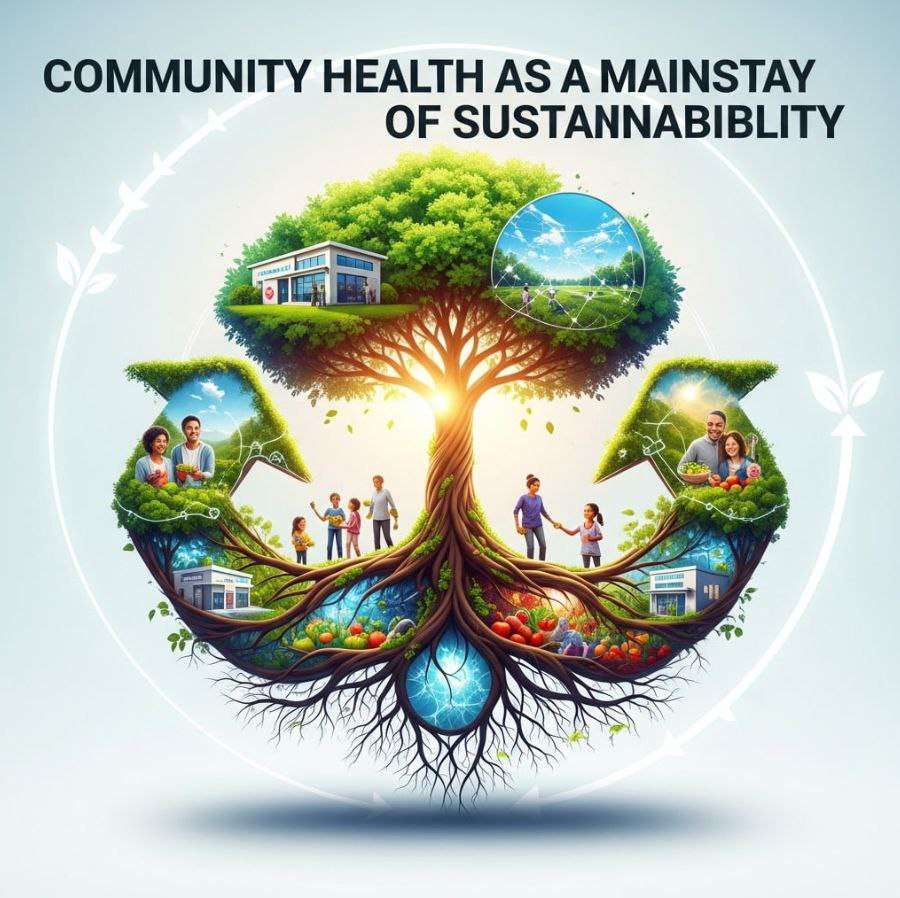
Community Health as a Mainstay of Sustainability
m.m:Noor Salman Obaid
m.m:Ahmed Mohammed Jawad Abdulbaqi
Public health is widely framed as a foundational requirement for sustainable development and, simultaneously, one of its most consequential outcomes (Acharya et al., 2018). Although Sustainable Development Goal 3 (SDG 3) explicitly targets “Good Health and Well-being,” health operates across the SDG agenda as a cross-cutting enabler and indicator of social, economic, and environmental progress (Egbende et al., 2023; Strzelecka, 2021). In this sense, population health has been described as a form of “insurance capital” that strengthens societal resilience and supports durable development pathways (Guégan & Moatti, 2018). This role is expressed through interdependent social, economic, and environmental channels.
Within the social domain, public health is shaped by upstream determinants such as poverty, education, and gender equality; persistent gaps in infrastructure and access to antenatal care are frequently associated with elevated maternal and child mortality and weakened social stability (Lakioti et al., 2025). Economically, evidence supports a reinforcing relationship between health and growth: healthier individuals tend to be more productive and better able to save and invest, while high out-of-pocket expenditures and
catastrophic health spending can impoverish households and threaten economic sustainability (Acharya et al., 2018; Niu et al., 2021). Environmentally, a substantial share of the global burden of disease is attributable to modifiable exposures such as air pollution and inadequate sanitation, underscoring that health gains are difficult to sustain when ecosystems are degraded (Acharya et al., 2018; Egbende et al., 2023).
Accordingly, the health–environment relationship is best understood as bidirectional. Planetary Health and One Health perspectives emphasize that long-term improvements in human well-being depend on the stable functioning of Earth’s natural systems and on managing shared risks at the human–animal–environment interface. Consistent with this systems framing, the World Health Organization estimates that approximately 23–24% of global deaths are linked to preventable environmental determinants (WHO, 2024).
- Ecological determinants of health
While social determinants of health (e.g., income and education) are well established, ecological determinants—planetary life-support systems—also condition health outcomes. Atmospheric stability is central: climate change is frequently characterized as a “threat multiplier,” intensifying heat stress, exacerbating food insecurity through crop disruption, and shifting the distribution of vector-borne diseases such as malaria and Zika (WHO, 2024). Access to safe water and sanitation (SDG 6) remains among the most effective environmental interventions, preventing large numbers of deaths from water-borne illness. Biodiversity and intact ecosystems provide critical services, including natural water purification and resources for biomedical discovery; conversely, habitat degradation and land conversion can increase opportunities for zoonotic spillover, as illustrated by recent pandemic experience.
- Health co-benefits of sustainability measures
A consistent finding in the sustainability literature is that environmental policies often produce immediate health co-benefits. Measures that reduce fossil-fuel combustion lower greenhouse gas emissions while simultaneously improving air quality and reducing morbidity and mortality from asthma, chronic respiratory disease, lung cancer, and cardiovascular disease. Similarly, dietary transitions toward more sustainable patterns—including reductions in excessive meat consumption—can lower agriculture’s environmental footprint and contribute to lower risk of non-communicable diseases such as obesity and type 2 diabetes (Lakioti et al., 2025).
- The One Health approach
٤. One Health provides an integrative framework that links the health of people with the health of animals and shared environments (Myers & Frumkin, 2025). Land-use change, including deforestation, can increase human–wildlife contact and elevate the risk of emerging infectious diseases. Chemical pollution, including heavy metals and microplastics, is associated with endocrine disruption and adverse neurodevelopmental outcomes. Climate-resilient and sustainable infrastructure can protect health facilities from extreme weather events and support continuity of care during disruptions.
Key interlinkages and synergies
Systems-based analyses of SDG interactions suggest that improvements in health can trigger reinforcing progress across other goals (Egbende et al., 2023). For instance, expanding access to water and sanitation (SDG 6) reduces diarrheal disease burden, which strengthens child health outcomes (SDG 3) and supports school attendance and learning (SDG 4). These cascading effects highlight how health can function as both a beneficiary of and a catalyst for broader sustainable development.
Challenges to sustainability in public health
Despite its centrality, sustaining public health interventions over time remains difficult. Evidence indicates that only about half of evidence-based interventions persist long enough to achieve durable impact, particularly in contexts characterized by structural barriers such as poverty, discrimination, and limited resources (Shelton et al., 2023). In fragile and conflict-affected settings, health systems are often disproportionately affected because progress depends strongly on improvements in governance, stability, and justice (SDG 16) (Bennich et al., 2023).
References
Acharya, S., Lin, V., & Dhingra, N. (2018). The role of health in achieving the sustainable development goals. Bulletin of the World Health Organization, 96(9), 591–591A. https://doi.org/10.2471/BLT.18.221432
Bennich, T., Persson, Å., Beaussart, R., Allen, C., & Malekpour, S. (2023). Recurring patterns of SDG interlinkages and how they can advance the 2030 Agenda. One Earth, 6(11), 1465–1476. https://doi.org/10.1016/j.oneear.2023.10.008
Egbende, L., Helldén, D., Mbunga, B., Schedwin, M., Kazenza, B., Viberg, N., Wanyenze, R., Ali, M. M., & Alfvén, T. (2023). Interactions between Health and the Sustainable Development Goals: The Case of the Democratic Republic of Congo. Sustainability, 15(2), 1259. https://doi.org/10.3390/su15021259
Guégan, J. F., & Moatti, J. P. (2018). Sustainable Development Goal #3, “health and well-being”, and the need for more integrative thinking. Salud Pública de México, 60(2).
Lakioti, E., Pagonis, N., Flegkas, D., Itziou, A., Moustakas, K., & Karayannis, V. (2025). Social Factors and Policies Promoting Good Health and Well-Being as a Sustainable Development Goal: Current Achievements and Future Pathways. Sustainability, 17(11), 5063. https://doi.org/10.3390/su17115063
Niu, X. T., Yang, Y. C., & Wang, Y. C. (2021). Does the Economic Growth Improve Public Health? A Cross-Regional Heterogeneous Study in China. Frontiers in Public Health, 9, 704155. https://doi.org/10.3389/fpubh.2021.704155
Shelton, R. C., Hailemariam, M., & Iwelunmor, J. (2023). Making the connection between health equity and sustainability. Frontiers in Public Health, 11, 1226175. https://doi.org/10.3389/fpubh.2023.1226175
Strzelecka, A. (2021). The Field of “Public Health” as a Component of Sustainable Development—Poland Compared to the European Union. Sustainability, 13(18), 10351. https://doi.org/10.3390/su131810351
Myers, S. S., & Frumkin, H. (2025). Planetary Health: Protecting Nature to Protect Ourselves (2nd ed.). Island Press.