Sustainability in Medical Education: Aligning Healthcare Training with Planetary Health Challenges
Prof. Shatha Hussein Kadhim
- Introduction
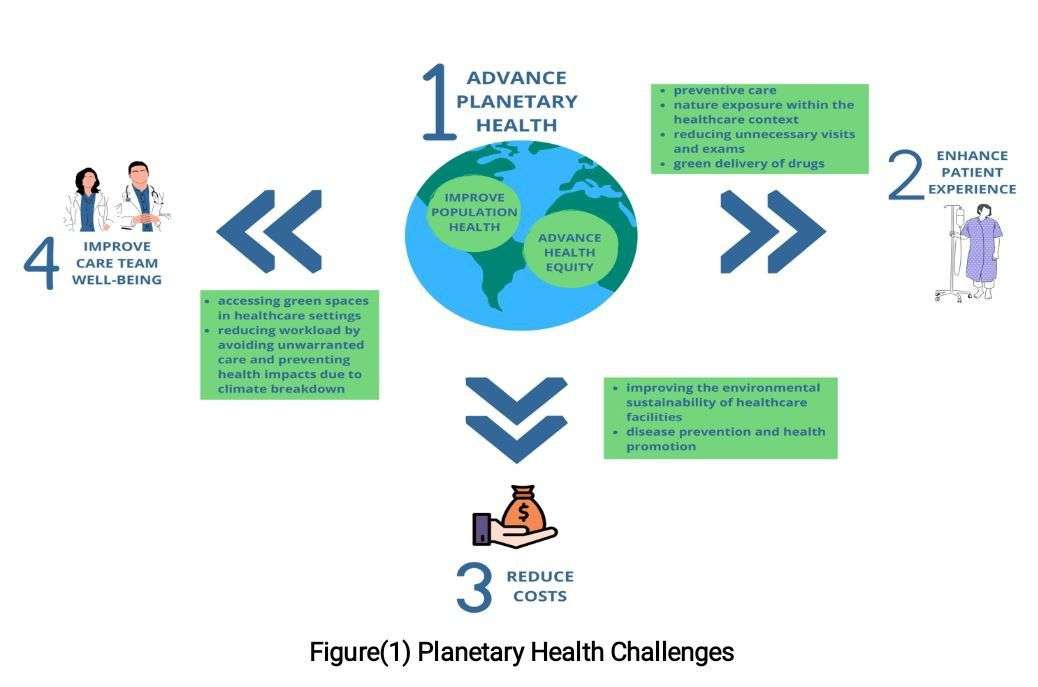
The relationship between human health and ecosystems has become a central challenge in 21st-century medicine. Climate change, biodiversity loss, air and water pollution, and unsustainable resource use are all factors that significantly and tangibly impact population health, healthcare demand, and healthcare system resilience. Paradoxically, healthcare delivery itself contributes significantly to environmental degradation, accounting for a substantial proportion of greenhouse gas emissions in many countries. These realities necessitate a reorientation of medical education toward sustainable competencies that equip future physicians to provide high-quality care while minimizing environmental harm. Sustainable medical education addresses this need by integrating the principles of environmental stewardship, climate science, and health equity into medical training. International policy frameworks and professional regulatory bodies increasingly recognize planetary health and sustainable healthcare as core professional responsibilities. However, translating these expectations into coherent and measurable curricula remains an ongoing challenge. This study examines the current state of sustainable medical education, with a particular focus on curriculum models, learner needs, and systemic barriers to implementation.
- Conceptual Foundations of Sustainable Medical Education
Sustainable medical education involves the systematic integration of knowledge, skills, and values, enabling clinicians to practice medicine within the constraints of the planet. At its core lies the recognition that the environmental determinants of health are inseparable from clinical outcomes and health equity. Sustainable medical education is typically grounded in the broader frameworks of planetary health and education for sustainable health, both of which emphasize the interconnectedness of human health, ecosystems, and social justice.
Key thematic areas within sustainable medical education include: (a) climate change and health, with a focus on heat-related illnesses, infectious disease dynamics, and the exacerbation of chronic diseases; (b) the environmental footprint of healthcare systems, including carbon emissions, waste generation, and resource consumption; and (c) environmental and health equity, recognizing the disproportionate burden of environmental damage on vulnerable populations. (Fourth) Professional responsibility and clinical decision-making that balances quality patient care with environmental sustainability.
- Regulatory and International Frameworks
In recent years, regulatory and educational bodies have begun to formalize sustainability expectations within medical training. In the UK, the Education for Sustainable Health (ESH) framework provides a structured curriculum that defines learning outcomes at all levels of undergraduate education.
University of Karbala, National Health Research Council
Medical education, with an emphasis on systems thinking and environmentally responsible clinical practice. Similarly, professional regulatory bodies, such as the General Medical Council, have incorporated planetary health and sustainability into their standards for medical education and training.
Similar initiatives are emerging internationally, reflecting a broader shift towards integrating sustainability competencies into accreditation and quality assurance processes. These frameworks indicate a move from optional enrichment content to core curriculum expectations, although their adoption and implementation vary considerably between institutions and regions.
- Curriculum Integration Strategies
٥. Multiple strategies have been proposed for integrating sustainability into medical curricula. Comprehensive longitudinal integration of existing courses is preferred over separate modules, as it strengthens their connection to core clinical competencies. Teaching approaches include case-based learning that explores the environmental implications of diagnostic and therapeutic choices, simulation exercises that address climate-related health emergencies, and interdisciplinary teaching involving students of medicine, nursing, pharmacy, and public health. Assessment remains a significant challenge. Emerging models focus on realistic assessment methods, such as reflective portfolios, quality improvement projects, and workplace-based assessments that measure students’ ability to apply sustainability principles in clinical settings. These approaches align with competency-based medical education while addressing the shortcomings of traditional written examinations in complex, systemically oriented subjects. - Learner Perspectives and Educational Needs
Pilot studies consistently demonstrate strong student support for integrating sustainability and planetary health into medical education. Surveys conducted in medical schools in the UK and elsewhere revealed high levels of concern about climate change and its health impacts, along with a widespread feeling of inadequate curriculum coverage. Importantly, students expressed a desire for clinically relevant, hands-on learning rather than purely theoretical content, highlighting the need for its integration into mainstream medical education.
However, student preferences regarding teaching methods vary, with some favoring long-term, integrated teaching, while others support e-learning or blended learning models. These findings underscore the importance of designing flexible curricula that respond to diverse learning needs.
- Implementation Barriers and Institutional Constraints
Despite growing momentum, several barriers hinder the systematic implementation of continuing medical education (CME) programs. Curriculum overcrowding remains a significant obstacle, limiting the introduction of new content. In addition, many faculty members cite limited training or confidence in teaching sustainability-related topics at the University of Karbala, College of Health Sciences.
This highlights the need for targeted faculty development initiatives. Assessment challenges further complicate implementation, as sustainability competencies are often difficult to measure using traditional examination methods. Therefore, institutional prioritization and leadership commitment are crucial for enabling curriculum reform and resource allocation.
- Research Gaps and Future Directions
While conceptual and descriptive literature on sustainability education is growing, robust empirical evidence remains limited. Notably, few longitudinal or experimental studies have assessed the impact of sustainability education on clinical decision-making, professional behavior, or patient outcomes. Similarly, comparative analyses of different educational approaches are scarce, hindering the identification of best practices.
Future research should prioritize longitudinal assessments of learner outcomes, the development of validated assessment frameworks, and exploring how sustainability competencies translate into real-world clinical practice. International collaboration will be essential for harmonizing educational standards and facilitating knowledge exchange.
- Conclusion
Sustainable medical education represents a crucial evolution in healthcare training, reflecting the urgent need to align medical practice with the demands of planetary health. With growing awareness and political support, the effective integration of curricula requires systematic implementation, faculty capacity building, and rigorous evaluation. Integrating sustainability as a core professional competency will enhance the quality of healthcare and the resilience of the system in the face of escalating environmental challenges.
References
Gupta, D. et al. (2022). Sustainable healthcare in medical education: Survey of student perspectives at a UK medical school. BMC Medical Education.
Medical Schools Council (2025). Education for Sustainable Healthcare – A Curriculum for the UK.
General Medical Council (UK) (2025). Planetary Health and Sustainable Healthcare in Medical Education: Standards and Outcomes.
Childs, J., Patel, A., & Joshi, A. (2020). Integrating sustainability into medical curricula: Educational challenges and perspectives. Medical Teacher.
Medical Students for a Sustainable Future. Education for Sustainable Healthcare curriculum guidance