
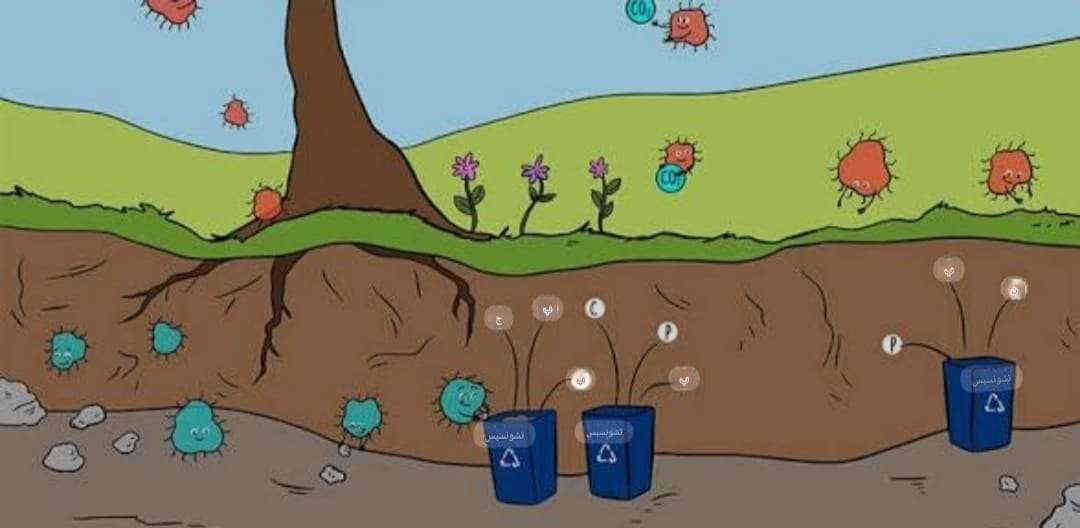
Transforming Waste into a Sustainable Green Environment Using Bacteria
M.M. Zahraa Rasool Talib Al-Husseini
Executive Summary
This article explores the role of microbial biotechnology in transforming waste into sustainable economic and environmental resources, based on the latest research published in Nature journals. We focus on the mechanisms of bacterial “cellular factories” in breaking down plastics, producing bioenergy, and extracting valuable metals. The results show that bacterial metabolic engineering can bridge the gap in the circular economy, despite challenges related to industrial-scale efficiency and cost.
Scientific Background and Basic Mechanisms:
Green sustainability through bacteria relies on the concepts of biodegradation and biosynthesis. Instead of viewing waste as an environmental burden, it is treated as a carbon- and energy-rich substrate.
1. Microbial Degradation of Plastics:
The problem of polyethylene terephthalate (PET) waste is one of the biggest challenges. According to studies in Nature Communications, bacteria such as Ideonella sakaiensis secrete specialized enzymes (PETase and MHETase) capable of breaking down the complex chemical bonds of plastics and converting them into basic monomers that can be recycled or used as an energy source for the bacteria.
2. Biofuel and Chemical Production:
Genetically engineered bacteria, such as Escherichia coli and Cupriavidus necator, are used to convert exhaust gases (such as CO and CO2) or agricultural waste into biofuels (such as butanol) or biodegradable plastics (PHAs).
Review of Recent Findings and Studies: Comparison and Analysis:
A review of research in the Nature family reveals a diversity of methodologies and findings:
Points of Agreement: Studies in Nature Reviews Microbiology and Nature Catalysis agree that microbial metabolism is the most sustainable approach compared to conventional thermochemical solutions, given its lower carbon footprint.
Points of Disagreement: Studies differ in their conversion efficiency. While Nature Microbiology research focuses on using mixed microbial communities (consortia) to ensure process stability, other research in Nature Biotechnology suggests that using a single, precision-engineered strain yields higher productivity of a given material, but is more susceptible to contamination.
1
Interpreting the results in simple terms:
Imagine bacteria as workers in a very small factory; these workers possess specialized “scissors” (enzymes) to cut through solid waste and transform it into new raw materials. Studies show that if we modify the “work map” (DNA) of these workers, they can work faster and withstand harsh environmental conditions.
Scientific limitations and research gaps:
Despite the optimism, articles in Nature Climate Change point to several obstacles:
Scalability: Most successes have been achieved in controlled laboratory environments; transferring this technology to large-scale waste treatment plants faces challenges in maintaining the stability of bacterial strains.
Cost: Extracting bioreactors from fermentation tanks remains expensive compared to conventional petroleum-based products.
Heterogeneous flows: The actual waste is not pure, and its presence of toxic substances may kill the “manufactured” bacteria.
Conclusion and future directions:
The shift towards bacteria-based “biorefineries” is a cornerstone of the green future. Trends in Nature Nanotechnology point to the integration of synthetic biology with nanomaterials to enhance electron transport in bacteria, which will increase the efficiency of energy production from waste.
References (Nature sources):
Yoshida, S., et al. (2016). A bacterium that degrades and assimilates poly(ethylene terephthalate). Nature.
Wei, R., et al. (2020). Biocatalytic recycling of polyethylene terephthalate. Nature Reviews Chemistry.
Nielsen, J., & Keasling, J. D. (2016). Engineering Cellular Metabolism. Nature.
Rabaey, K., & Rozendal, R. A. (2010). Microbial electrosynthesis — revisiting the electrical route for microbial production. Nature Reviews Microbiology.
Arnold, F. H. (2018). Directed evolution: Bringing new chemistry to life. Nature Communications.