
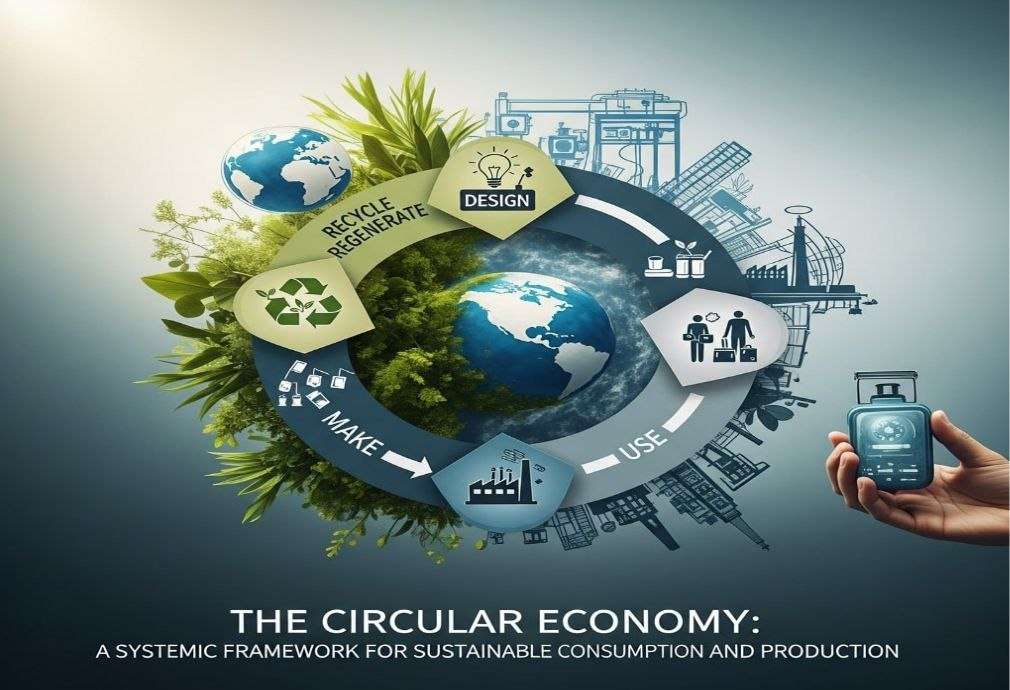
The Circular Economy: A Systemic Framework for Sustainable Consumption and Production
m.m.Zeina Haider Abbas
To transition meaningfully toward global sustainability, we must confront a fundamental flaw in our dominant economic model: the "take-make-dispose" linear system. This model extracts finite resources, transforms them into products, and discards them as waste, creating immense environmental degradation and resource insecurity. A compelling alternative exists: the Circular Economy (CE). This approach requires us to ask: How can we design waste out of our systems? How can we keep products and materials in use for as long as possible? And what are the tangible benefits of such a shift for businesses, societies, and the biosphere?At its core, the Circular Economy is a model of production and consumption that involves sharing, leasing, reusing, repairing, refurbishing, and recycling existing materials and products for as long as possible (Ellen MacArthur Foundation, 2013). It is inspired by natural ecosystems, where there is no concept of waste—outputs from one process become inputs for another. This model directly supports the pillars of sustainable development: it promotes environmental regeneration by reducing resource extraction and pollution, offers economic opportunity through innovation and new business models, and fosters social equity by potentially reducing costs and creating localized, resilient economies. Our focus here is on the transformative potential of circularity in mitigating resource depletion and climate change.
3
Principles and Pillars of the Circular Economy
The CE is built on three core principles, derived from nature: 1) Eliminate waste and pollution, 2) Circulate products and materials at their highest value, and 3) Regenerate natural systems (Ellen MacArthur Foundation, 2019). These are operationalized through two fundamental cycles:
- The Technical Cycle: This focuses on recovering and restoring products, components, and materials through strategies like reuse, repair, remanufacturing, and recycling. The goal is to keep finite materials in circulation and out of landfills. For example, a manufacturer might design a smartphone for easy disassembly, enabling the recovery of precious metals and rare earth elements for use in new devices.
- The Biological Cycle: This involves returning biodegradable materials to the earth through processes like composting and anaerobic digestion, thereby regenerating living systems. Food waste, for instance, becomes nutrient-rich compost for agriculture, closing the nutrient loop and reducing reliance on synthetic fertilizers.
Central to enabling these cycles is circular design. Products must be intentionally designed from the outset for durability, reparability, and eventual disassembly—a concept known as Design for the Circular Economy (DfCE) (Bocken et al., 2016). This shifts responsibility from the end-user to the producer, a principle reinforced by policy frameworks like Extended Producer Responsibility (EPR).
Barriers to Circular Transition
 Despite its promise, the transition from a linear to a circular economy faces significant systemic barriers. Economically, our markets are structured around the high-volume, low-cost sale of new goods. Virgin materials are often subsidized or cheaper than recycled alternatives due to externalized environmental costs (Kirchherr et al., 2018). This creates a price disadvantage for circular products and services.

 Culturally, dominant consumption patterns are built on ownership and novelty, fueled by marketing that equates status with the "new." The "fast fashion" and frequent electronics upgrade cycles are prime examples. Technologically, many existing products are not designed for circularity; their complex material mixes make them difficult and uneconomical to disassemble and recycle.
Furthermore, regulatory frameworks often lag, inadvertently favoring linear models. Outdated waste management regulations or a lack of standards for secondary materials can stifle circular innovation. Overcoming these barriers requires a concerted, multi-stakeholder effort.
Strategies and Enablers for a Circular Future
Accelerating the circular transition demands integrated action across all levels of society:
- Innovative Business Models: Companies must adopt models that decouple revenue from resource consumption. These include:
Product-as-a-Service: Leasing products (e.g., lighting, clothing, machinery) where the manufacturer retains ownership and responsibility for maintenance, repair, and end-of-life recovery (Tukker, 2015).
Sharing Platforms: Maximizing asset utilization through peer-to-peer sharing of cars, tools, or appliances.
Remanufacturing and Refurbishment: Creating high-quality, certified “like-new” products from used components, offering significant environmental and cost savings.
- Supportive Policy and Regulation: Governments must create the enabling conditions. This includes:
Implementing and strengthening Extended Producer Responsibility (EPR) schemes.
Reforming taxation to favor labor (e.g., repair) over virgin resource extraction and pollution.
Setting mandatory recycled content targets for key materials like plastics and electronics.
Public procurement policies that prioritize circular, durable goods.
- Cross-Sectoral Collaboration and Digitalization: No single company can create a circular system alone. Industry-wide collaboration is needed to standardize materials, design protocols, and reverse logistics. Digital technologies like the Internet of Things (IoT) and block chain can track materials flows, optimize sharing platforms, and verify the provenance of recycled content.
- Consumer Engagement and Education: Shifting cultural norms is essential. This involves promoting repair cafés, supporting brands with take-back schemes, and educating the public on the true environmental and social cost of disposability. Transparency about product lifecycle impacts can empower more conscious consumption choices.
Conclusion
The Circular Economy is not merely a waste management strategy but a profound systemic shift towards a regenerative and restorative industrial model. It presents a viable pathway to achieve decoupling—growing economic prosperity while reducing pressure on finite resources and fragile ecosystems. By embracing circular design, innovative business models, and enabling policies, we can move from an economy that consumes the planet to one that aligns with its cyclical processes. The transition is complex and requires dismantling entrenched linear systems, 3
but the reward is an economy built for the long term—one that is inherently more resilient, innovative, and sustainable for future generations.
References
- Bocken, N. M., de Pauw, I., Bakker, C., & van der Grinten, B. (2016). Product design and business model strategies for a circular economy. Journal of Industrial and Production Engineering, 33(5), 308-320.
- Ellen MacArthur Foundation. (2013). Towards the Circular Economy Vol. 1: An economic and business rationale for an accelerated transition.
- Ellen MacArthur Foundation. (2019). Completing the Picture: How the Circular Economy Tackles Climate Change.
- Geissdoerfer, M., Savaget, P., Bocken, N. M., & Hultink, E. J. (2017). The Circular Economy–A new sustainability paradigm? Journal of Cleaner Production, 143, 757-768.
- Kirchherr, J., Piscicelli, L., Bour, R., Kostense-Smit, E., Muller, J., Huibrechtse-Truijens, A., & Hekkert, M. (2018). Barriers to the Circular Economy: Evidence from the European Union (EU). Ecological Economics, 150, 264-272.
- Korhonen, J., Honkasalo, A., & Seppälä, J. (2018). Circular economy: The concept and its limitations. Ecological Economics, 143, 37-46.
- Lacy, P., & Rutqvist, J. (2015). Waste to Wealth: The Circular Economy Advantage. Palgrave Macmillan.
٨. 8. Murray, A., Skene, K., & Haynes, K. (2017). The Circular Economy: An Interdisciplinary Exploration of the Concept and Application in a Global Context. Journal of Business Ethics, 140(3), 369-380. - Stahel, W. R. (2016). The circular economy. Nature, 531(7595), 435-438.
- Tukker, A. (2015). Product services for a resource-efficient and circular economy–a review. Journal of Cleaner Production, 97, 76-91.