
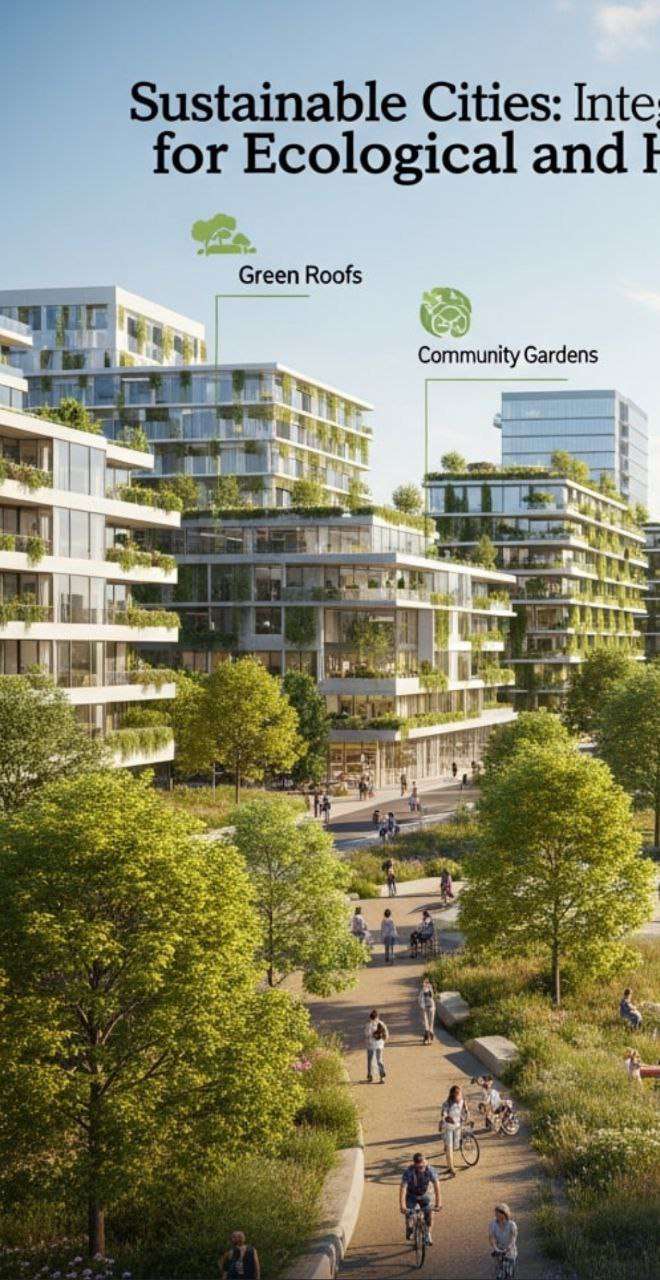
Sustainable Cities: Integrating Urban Green Spaces for Ecological and Human Well-being
m.m. sarah muhamad muhsin
    To address sustainability in an urban context, foundational questions must first be explored. What role do cities play in global sustainability? How can urban development balance growth with ecological limits? And critically, how does the design of our urban environments directly impact both planetary and public health?

  Sustainable development, as defined by the Brundtland Commission, is “development that meets the needs of the present without compromising the ability of future generations to meet
their own needs” (World Commission on Environment and Development, 1987). This principle hinges on the interdependent pillars of social equity, environmental integrity, and economic viability. In an increasingly urbanized world—where over 55% of the global population resides in cities—achieving sustainability demands a concentrated focus on urban ecosystems. A pivotal strategy within this realm is the intentional integration and preservation of Urban Green Spaces (UGS), including parks, green roofs, urban forests, community gardens, and permeable landscapes. These are not mere amenities but critical infrastructure for resilient, sustainable cities.
The Multifaceted Role of Urban Green Spaces
  UGS serve as the ecological lungs and social hearts of cities, directly addressing core sustainability challenges. Ecologically, they are vital for climate change adaptation and mitigation. Urban vegetation sequesters carbon, reduces the Urban Heat Island (UHI) effect—where built-up areas are significantly warmer than surrounding rural areas—and manages stormwater runoff, mitigating flood risks (IPCC, 2022). A study by Nowak et al. (2014) emphasized that U.S. urban trees alone remove millions of tons of air pollutants annually, directly contributing to environmental health.

   From a social perspective, access to UGS is strongly linked to improved human health and equity. They provide spaces for physical activity, reduce stress, and improve mental well-being (WHO, 2016). Furthermore, urban agriculture components of UGS, such as community gardens, enhance local food security and provide educational opportunities (Opitz et al., 2016). Economically, well-maintained green spaces increase property values, boost local tourism, and reduce public health costs by promoting healthier lifestyles (Wolf, 2018). Thus, UGS uniquely synergize all three pillars of sustainability.
Challenges and Threats to Urban Green Infrastructure
   Despite their value, UGS face significant pressures that threaten urban sustainability. Primary among these is urban densification and land-use competition. As cities grow, green spaces are often sacrificed for housing, commercial development, or transportation infrastructure, a process termed "green space loss" (Haaland & van den Bosch, 2015). This loss is frequently inequitable; marginalized and low-income communities often have less access to quality UGS, exacerbating social and health disparities (Rigolon et al., 2018). This creates “green deserts” in areas that need them most.

   Additionally, many existing UGS suffer from poor management, pollution, and a lack of biodiversity, limiting their ecological functionality. Monoculture lawns, for instance, offer minimal habitat value and require high water and chemical inputs. Climate change itself poses a threat, with increased droughts and heat waves stressing urban plant life. These challenges highlight that the mere existence of green space is insufficient; its quality, accessibility, and design are paramount.
Strategies for Mainstreaming Green Infrastructure
Transitioning towards sustainable cities requires proactive, integrated strategies to protect, enhance, and equitably distribute UGS.- Policy Integration and Green Urban Planning: Sustainable urban development must mandate UGS through zoning laws, green space ratios (e.g., per capita standards), and Green Infrastructure (GI) mandates. Policies like requiring green roofs on new commercial buildings or protecting urban forest corridors should be standard (Beatley, 2011). Master plans must prioritize multi-functional green networks over isolated parks.
- Promoting Biodiverse and Native Landscaping: Moving beyond ornamental landscapes to native, climate-resilient plantings is crucial. This enhances local biodiversity, provides habitat for pollinators, reduces water and pesticide needs, and strengthens ecosystem resilience (Aronson et al., 2017). Cities should incentivize the replacement of impervious surfaces with rain gardens and bio-swales.
- Ensuring Equitable Access and Community Co-management: Planning must focus on creating or revitalizing green spaces in underserved neighborhoods. Successful models often involve participatory design and co-management with local communities, fostering ownership and ensuring spaces meet local needs (Anguelovski et al., 2018). This transforms UGS from top-down projects into cherished community assets.
- Leveraging Technology and Innovative Design: Smart irrigation systems, soil moisture sensors, and the use of treated greywater can optimize water use in parks. Vertical gardens and green walls can introduce nature in space-constrained areas. Digital tools like GIS can map access and canopy cover to identify and address inequities.
Conclusion
Urban Green Spaces are far more than decorative afterthoughts; they are foundational to the sustainable city of the future. They represent a tangible solution where environmental action—carbon sequestration, cooling, and biodiversity support—delivers immediate social and economic co-benefits. As urbanization accelerates, the deliberate weaving of green infrastructure into the urban fabric is not a luxury but a necessity for climate resilience, public health, and social cohesion. By championing policies that protect existing greenspaces, create new ones with ecological and social intent, and ensure their equitable distribution, we can build cities that are not only sustainable but also truly livable for all generations.
References
- Anguelovski, I., Connolly, J. J., Garcia-Lamarca, M., Cole, H., & Pearsall, H. (2018). New scholarly pathways on green gentrification: What does the urban ‘green turn’ mean and where is it going? Progress in Human Geography, 43(6), 1064-1086.
- Aronson, M. F., et al. (2017). Biodiversity in the city: key challenges for urban green space management. Frontiers in Ecology and the Environment, 15(4), 189-196.
- Beatley, T. (2011). Biophilic cities: integrating nature into urban design and planning. Island Press.
- Haaland, C., & van den Bosch, C. K. (2015). Challenges and strategies for urban green-space planning in cities undergoing densification: A review. Urban Forestry & Urban Greening, 14(4), 760-771.
- IPCC. (2022). Climate Change 2022: Impacts, Adaptation and Vulnerability. Contribution of Working Group II to the Sixth Assessment Report of the Intergovernmental Panel on Climate Change. Cambridge University Press.
- Nowak, D. J., Hirabayashi, S., Bodine, A., & Greenfield, E. (2014). Tree and forest effects on air quality and human health in the United States. Environmental Pollution, 193, 119-129.
- Opitz, I., Berges, R., Piorr, A., & Krikser, T. (2016). Contributing to food security in urban areas: differences between urban agriculture and peri-urban agriculture in the Global North. Agriculture and Human Values, 33(2), 341-358.
- Rigolon, A., Browning, M., & Jennings, V. (2018). Inequities in the quality of urban park systems: An environmental justice investigation of cities in the United States. Landscape and Urban Planning, 178, 156-169.
- WHO. (2016). Urban green spaces and health: a review of evidence. World Health Organization Regional Office for Europe.
١٠. 10. Wolf, K. L. (2018). Urban forest values. In The Routledge Handbook of Urban Forestry (pp. 75-92). Routledge. - World Commission on Environment and Development. (1987). Our Common Future. Oxford University Press.