
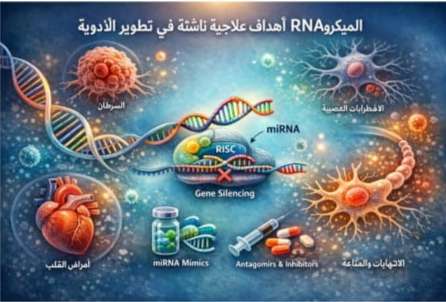
MicroRNAs: Emerging Therapeutic Targets in Drug Development
Professor Dr. Suzanne Jubair Abbas
The recent discovery of microRNAs (miRNAs) has fundamentally transformed our understanding of gene expression regulation at the post-transcriptional level, shedding light on a previously unknown, complex regulatory layer. These small, non-coding molecules play a pivotal role in controlling essential biological pathways, including cell differentiation, proliferation, apoptosis, and immune response. With mounting evidence linking microRNA dysregulation to a wide range of human diseases, including cancer, heart disease, neurological disorders, and inflammatory diseases, microRNAs have emerged as promising therapeutic targets in modern drug development. This article reviews the molecular basis of microRNA function, the mechanisms of their pathogenic dysregulation, and pharmacological strategies based on modifying their activity, as well as the pharmacological and biological challenges to their clinical translation, while highlighting their future prospects in personalized medicine and targeted therapies.
1- Introduction
Over the past two decades, molecular pharmacology has witnessed remarkable development due to its increasing convergence with molecular biology and functional genomics. The focus has shifted from proteins as traditional drug targets to non-coding regulatory molecules that play central roles in controlling gene networks. Among these molecules, microRNAs have emerged as precise regulatory agents capable of influencing hundreds of genes simultaneously, granting them regulatory power exceeding that of many traditional transcription factors.
MicroRNAs are short (≈ 18–25 nucleotides) non-coding RNA molecules that inhibit messenger RNA (mRNA) translation or induce its degradation, thereby controlling intracellular protein levels. Their discovery has redefined the concepts of gene regulation and disease, opening new avenues for developing innovative therapeutic strategies in modern pharmacology.
2- Biological Origin of MicroRNA and its Molecular Mechanism of Action
The process of microRNA synthesis begins within the nucleus with the transcription of specific genes by RNA polymerase II to form precursor molecules known as pri-miRNAs. These molecules undergo cleavage by the Drosha-DGCR8 complex to become pre-miRNAs, which are then transported to the cytoplasm via Exportin-5. In the cytoplasm, the enzyme Dicer cleaves the pre-miRNA to form a mature miRNA doublet, one strand of which is incorporated into the RNA silencing complex (RISC).
This complex binds to partially complementary sequences in the 3′-UTR untranslated region of the target mRNA, leading to either translation inhibition or messenger RNA degradation. The biological significance of this mechanism lies in the fact that a single miRNA can regulate dozens or even hundreds of genes, making it a crucial element in the control of complex cellular networks.
- The Role of MicroRNAs in Pathophysiology
Studies have shown that abnormal expression of microRNAs is closely linked to the development of many diseases. In cancer, some microRNAs can be classified as oncomiRs when they promote tumor growth by suppressing tumor suppressor genes, while others act as tumor suppressor miRNAs by suppressing oncogenes.
In cardiovascular diseases, microRNAs play a role in regulating myocardial hypertrophy, fibrosis, and atherosclerosis. In the nervous system, they have been implicated in neurodegenerative diseases such as Alzheimer’s and Parkinson’s, through their effects on neuronal survival and neuroinflammation.
MicroRNAs also contribute to the regulation of the immune response and inflammation, and their dysfunction leads to autoimmune diseases and chronic inflammatory disorders, making them attractive targets for therapeutic intervention.
- MicroRNAs as Therapeutic Targets in Drug Development
4.1 MicroRNA Inhibition Strategies
This strategy relies on the use of synthetic molecules such as antagomirs or locked nucleic acids (LNAs), which bind to overexpressed microRNAs and prevent their interaction with their genetic targets. This approach has shown promising results in animal models, particularly in cancer and heart disease.
4.2 MicroRNA Compensation Strategies
In cases where disease-suppressing microRNAs are deficient or lose their function, miRNA mimics can be used to restore their functional activity. These molecules aim to mimic natural microRNAs and restore genetic balance within the cell.
- Pharmaceutical and Biological Challenges
Despite their promising therapeutic potential, microRNA-based therapies face significant challenges, most notably the difficulty of delivering the molecules to target tissues, their susceptibility to degradation by nucleases, and the potential for off-target effects due to the multi-target nature of microRNAs. Challenges also arise concerning long-term safety and immune response. - Clinical Applications and Drug Trials
The last decade has seen several microRNA-based therapies enter clinical trials, such as Miravirsen (a miR-122 inhibitor) for hepatitis C. This has provided practical evidence of the potential for translating these molecular concepts into real-world therapeutic applications, although some trials have been halted due to safety or efficacy concerns. - Future Prospects
The integration of microRNA technologies with personalized medicine represents a paradigm shift in drug development, enabling the design of customized treatments based on each patient’s molecular signature. Advances in nanotechnology and drug delivery may help overcome current obstacles, enhancing the prospects for the clinical adoption of these therapies in the near future. - Conclusion
MicroRNA is among the most promising therapeutic targets in modern molecular pharmacology, given its central role in regulating complex genetic networks. Despite the technical and clinical challenges, ongoing progress in understanding its biology and developing advanced delivery systems makes it a strong candidate to become a key component of future therapeutic arsenals, particularly in the context of precision medicine and targeted therapy.
Scientific references
1-Bartel, D.P. (2004). MicroRNAs: genomics, biogenesis, mechanism, and function. Cell, 116(2), 281–297.
https://doi.org/10.1016/S0092-8674(04)00045-5
2-Bartel, D.P. (2009). MicroRNAs: target recognition and regulatory functions. Cell, 136(2), 215–233.
https://doi.org/10.1016/j.cell.2009.01.002
3-Rupaimoole, R., & Slack, F.J. (2017). MicroRNA therapeutics: towards a new era for the management of cancer and other diseases. Nature Reviews Drug Discovery, 16, 203–222.
https://doi.org/10.1038/nrd.2016.246
4-Hanna, J., & Hossain, G.S. (2019). The potential for microRNA therapeutics and clinical research. Frontiers in Genetics, 10, 478.
https://doi.org/10.3389/fgene.2019.00478
5-Chakraborty, C., et al. (2017). Therapeutic advances of miRNAs: a preclinical and clinical update. Journal of Advanced Research, 8(5), 479–491.
https://doi.org/10.1016/j.jare.2017.05.004
6-van Rooij, E., & Olson, E.N. (2012). MicroRNA therapeutics for cardiovascular disease. Circulation Research, 110(3), 496–507.
https://doi.org/10.1161/CIRCRESAHA.111.247452