
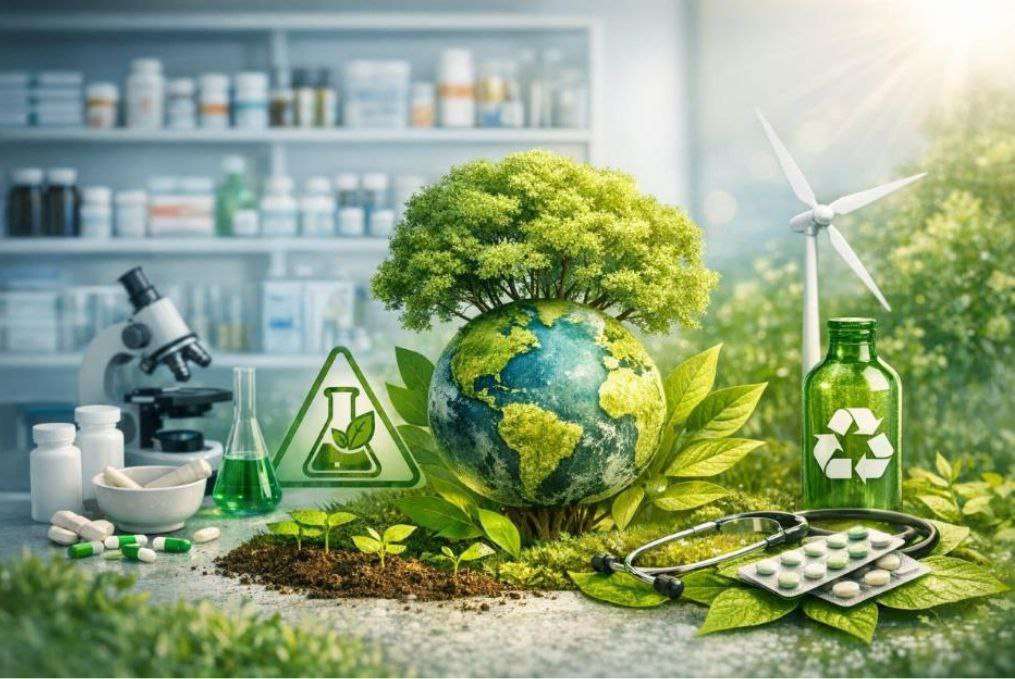
Sustainability in Pharmaceutical Sciences: A Contemporary Vision of the Pharmacist’s Role in Protecting Health and the Environment
A.M. Jinan Mohammed Mohsen
Introduction
In recent decades, the world has witnessed a significant escalation in environmental challenges that threaten human health and the sustainability of natural resources. This has directly impacted various scientific and medical sectors, including pharmaceutical sciences. Developing and providing medication to patients is no longer the sole objective of modern pharmacy. It has become essential to consider the long-term environmental and health impacts associated with drug production, use, and disposal. Hence, the concept of
sustainability in pharmaceutical sciences has emerged as a scientific and ethical approach that seeks to achieve a balance between the requirements of effective treatment and environmental preservation.
The Pharmacist’s Role in Protecting Health and the Environment
Pharmaceutical sustainability relies on a comprehensive understanding of the drug lifecycle, from research and development through manufacturing, packaging, and distribution, to clinical use and the disposal of expired pharmaceutical products. This integrated approach highlights the responsibility of pharmacists and pharmaceutical professionals in minimizing waste, conserving resources, and reducing the undesirable environmental impacts that can result from traditional practices.
In the pharmaceutical manufacturing process, the pharmaceutical industry is among the most energy- and chemical-intensive industries, particularly in the use of organic solvents, which can be highly toxic and have harmful environmental effects. This has led to increased interest in applying green chemistry principles in the pharmaceutical field by improving the efficiency of chemical reactions, reducing the number of manufacturing stages, and using materials that are less hazardous to humans and the environment. Adopting these principles not only contributes to environmental protection but also improves the quality of pharmaceutical products and reduces long-term economic costs.
In daily pharmaceutical practice, the importance of sustainability is evident in the rational handling of both prescription and over-the-counter medications. Numerous reports indicate that a significant percentage of medications are wasted due to improper storage, non-adherence to treatment plans, or dispensing quantities exceeding the patient’s actual needs. This waste not only represents an economic loss but also leads to environmental pollution when medications are improperly disposed of, especially those that end up in water sources and affect ecosystems and living organisms.
Herein lies the pivotal role of the pharmacist in promoting sustainable practices by educating patients about the optimal use of medications, the importance of adhering to prescribed dosages, and proper storage methods, in addition to providing guidance on the safe disposal of expired medications. Pharmacists can also contribute to reducing the environmental burden by encouraging the prescription of medications only when necessary and participating in programs to reduce antibiotic overuse, given its direct impact on public health and the environment.
Healthcare institutions, particularly hospitals and pharmacies, play a fundamental role in supporting pharmaceutical sustainability by adopting effective medical and pharmaceutical waste management systems, reducing reliance on single-use plastics, and moving towards more sustainable packaging solutions. These measures, despite their apparent simplicity, are important steps towards reducing the environmental footprint of the healthcare sector and promoting the concept of social responsibility.
The academic role in establishing sustainability concepts within pharmaceutical sciences cannot be overlooked
.Integrating sustainability and green chemistry into pharmacy curricula is a crucial step in preparing a generation of pharmacists with environmental awareness alongside their scientific and professional competence. This early awareness contributes to building a professional culture based on therapeutic and manufacturing decisions that consider both human health and the environment.
In light of the above, it can be said that sustainability in pharmaceutical sciences is no longer a secondary option, but rather a necessity imposed by contemporary health and environmental challenges. Adopting this concept contributes to developing a more efficient and responsible pharmaceutical practice and strengthens the pharmacist’s role as a key partner in protecting public health and preserving natural resources. Therefore, supporting academic and professional initiatives that seek to establish sustainability as an integral part of the future of pharmaceutical sciences is of paramount importance.
Conclusion
In light of increasing environmental and health challenges, sustainability in pharmaceutical sciences emerges as a necessary path for developing pharmaceutical practice in line with the demands of the modern era. Adopting sustainability concepts is not limited to reducing the environmental impact of the pharmaceutical industry, but extends to improving the quality of healthcare, rationalizing the use of resources, reducing drug waste, and promoting the safety of both society and the environment.
The pharmacist is a pivotal element in this transformation, whether through their role in pharmaceutical manufacturing, clinical practice, or in educating patients and the community. Furthermore, integrating sustainability principles into pharmaceutical education contributes to preparing a conscious generation capable of making responsible professional decisions that consider the environmental dimension alongside the therapeutic one. Therefore, supporting academic and research initiatives that promote the concept of sustainability is a fundamental step towards building a more efficient and sustainable healthcare system that serves humanity and preserves the environment for future generations.
Sources
Sheldon, R.A. (2017) ‘The rise of green chemistry and sustainability’, Green Chemistry, 19(1), pp. 18–43. https://doi.org/10.1039/C6GC02157C
Thakur, V.K. and Thakur, M.K. (2016) ‘Recent advances in green materials for pharmaceutical applications’, Carbohydrate Polymers, 153, pp. 506–522. https://doi.org/10.1016/j.carbpol.2016.07.086
Kumar, S. and Bhowmik, D. (2018) ‘Role of natural excipients in pharmaceutical formulations’, International Journal of Pharmaceutical Sciences Review and Research, 50(1), pp. 1–10.
World Health Organization (2019) Safe management of wastes from health-care activities. Geneva: WHO Press.
European Medicines Agency (2020) Guideline on the environmental risk assessment of medicinal products. Available at: https://www.ema.europa.eu (Accessed: 2026).