
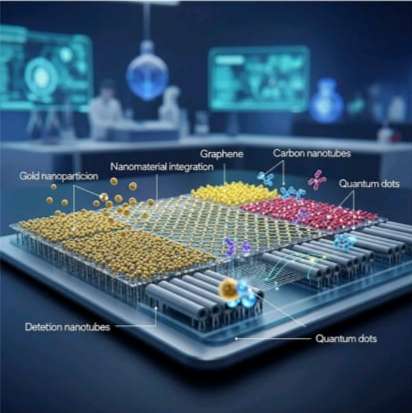
Nano materials applications in biosensor
Professor Dr. Nada Yahya Fayrouz
Introduction
Nanomaterials have recently aroused much interest due to the increased need for control of desired molecules present in the human body and environment (B. Lagerqvist,2007). A nanomaterial comprises of nanoparticles (NPs) that are less than 100 nm at least in one dimension. The term “nanotechnology”deals with small-sized materials when the size is down to subnanometer or several hundred nanometers (G.A. Ozin.,2009). The controlled synthesis and tuning properties of nanomaterials require knowledge of different disciplines such as physics, chemistry, electronics, computer science, biology, engineering, agriculture, etc. that may lead to the
emergence of novel and multifunctional nanotechnologies. In this context, the exciting properties of nanomaterials have attracted the world scientific community toward their application in various sectors such as health, food, security, transport, and information technology, etc. The intelligent use of nanomaterials is predicted to enhance the performance of biomolecular electronic devices with high sensitivities and detection limits.
Diagnostics is clinically important both for identification of a disease and therapeutics. Early diagnostics plays an important role to detect a disease (prevention) or the outcome of a disease (prognosis). A number of biodevices have been fabricated for studies of blood gas, glucose/lactate/cholesterol, nucleic acid sequence analysis, proteins/peptides, combinatorial synthesis, toxicity monitoring, immunoassays, environment, defense, and forensic analysis. A biosensor for blood glucose monitoring has been successfully commercialized (Fig.1)
Figure 1: A blood glucose biosensor (https://www.pulsatom.com/.).
1- Gold nanoparticles (GNPs)
Tiny structures of at least one scale less than 100 nm, are firstly noticed by Michael Faraday in 1857, while he produced gold nanoparticles and observed that nanostructured gold emitted a red color. Commenting on fact (the more dilute preparations = solution become clear), goes on to say: ‘‘holding no disbanded, except uniquely diffused gold. The particles are simply speckled by collecting the sun’s rays (or the candle) into the cone by the lens, and dropping the part of the cone near the middle into the liquid; the cone becomes visible, and although the lighted particles cannot be recognized by their thoroughness, the radiance they shine back is golden, and is detect to be plentiful in ratio to the amount of solid gold. This is the primary clearly expressed explanation of which at present called the Tyndall impact. This distinct characteristic of gold nanoparticles may be due to its minute size. The AuNPs are very small relative to the wavelengths of light, absorbing light in the blue-green part of the
spectrum (~450 nm), and reflecting red light (~700 nm) provides a rich red color (ruby gold). After Michael Faraday’s discovery, it was the birth of modern nanotechnology; and many scientists took this approach because of its fertile field of research (Ansari, 2019; Edwards and Thomas, 2007) (see Figs. 2 ).
2- Carbo nanotubes (CNTs) and Graphene
In SWCNT-based biosensors, biomolecules can be immobilized by adsorption onto the polymer or the walls of the SWCNTs (often by electrostatic or hydrophobic interactions), by entrapment during polymer growth or by anchorage via covalent binding and affinity interactions (Fig. 4).
Immobilized biomolecules in SWCNT/conducting polymer composites provide the biospecific selectivity necessary for detecting the oxidation of bio-relevant small molecules such as H2O2, NADH, dopamine or detecting biospecific binding events such as hybridization and immunoreactions. Compared to classic planar electrodes, a SWCNT network leads to a higher electrode surface area increasing the density of immobilized enzymes, ssDNA or specific antibodies, hence, increasing the biosensor sensitivity.
Figure. 4 Immobilization strategies of enzymes on SWCNTs: (a) covalent binding via amide coupling with the carboxylic acid groups of oxidized nanotubes; (b) electrochemical coating of nanotubes with affinity partners and subsequent immobilization of affinity counter part modified enzymes; (c) adsorption of enzymes on SWCNTs via hydrophobic or electrostatic ineractions; (d) entrapment of enzymes in a polymer matrix formed around SWCNTs; and (e) immobilization via affinity interactions onto functionalized nanotubes.( Alan Le Goff.,2011)
3- Magnetic nanoparticles (MNPs)
Food safety has attracted increasing concerns globally (King et al. 2017; Omari et al. 2018). Foodborne illnesses are mainly caused by 15 pathogenic bacteria through the consumption of contaminated foods (Chen and Park 2017a). E. coli O157:H7 is one of the major foodborne pathogenic bacteria and can often result in such serious diseases as hemolytic uremic syndrome, bloody diarrhea and even death (Jiang et al. 2016b; Zeinhom et al. 2018b). Existing methods for detection of E. coli O157:H7 mainly include culture plating (Culture), polymerase chain reaction (PCR), and enzyme-linked immune-sorbent assay (ELISA), etc. (Yao et al. 2018). Culture is the gold standard method with high reliability and sensitivity; however, it is time-consuming and generally needs 2-3 d. PCR is recommended in China’s food safety national standards with short time and high sensitivity, however it often requires well-trained technicians and complex DNA extraction procedure . ELISA is featured with rapid detection and high throughput; however, it lacks sufficient sensitivity and often has a low detection limit of 104 CFU/mL (Feng et al. 2013;
Wu et al. 2015). Therefore, it is crucial to develop simple, sensitive and rapid methods for bacteria detection to ensure food safety.
4- Visual infection responsivity as a biosensor for wound infection
In chronic wounds, such as leg and diabetic foot ulcers, infection requires antibiotic therapy and frequent hospitalisation, and may, in some cases, lead to surgery (Callam,1985; Nelzen, O,1996) . With the spread of antimicrobial resistance, infection causes increased wound chronicity and risks of gangrene and amputation, creating a burden on patients and healthcare providers worldwide (Schafer, M,2008;Furusaw,C., 2018). Continuous chronic wound monitoring is therefore a promising strategy to enable early detection of infection, aid diagnosis and inform therapeutic decisions (Dargaville, T.R,2013). At the same time, reliable wound monitoring devices are still hardly realised, due to the complex infection mechanisms and healing process of these wounds (Schroter, A,2012). Aiming at next-generation wound care, multifunctional cost-effective wound management products are therefore needed to support healing in non-self-healing wounds and to signal the occurrence of infection by e.g., visual effects ( Singh, A.V.,2010 ).
References
B. Lagerqvist, S.K. James, U. Stenestrand, J. Lindbäck, T. Nilsson, L. Wallentin,Long-term outcomes with drug-eluting stents versus bare-metal stents in Sweden,N. Engl. J. Med. 356 (2007) 1009e1019.
G.A. Ozin, A.C. Arsenault, L. Cademartiri, Nanochemistry: A Chemical Approach to Nanomaterials, second ed., Royal Society of Chemistry, 2009.
https://www.pulsatom.com/.
Ansari, M.J., editor Transport Phenomenon of Nanoparticles in Animals and Humans. Diffusion Foundations; 2019: Trans Tech Publ.
Edwards, P., Thomas, J., 2007. Gold in a metallic divided state—from faraday to present-day. Nanoscience 46 (29), 5480–5486.
king, T., Cole, M., Farber, J.M., Eisenbrand, G., Zabaras, D., Fox, E.M., Hill, J.P., 2017. Food safety for food security: Relationship between global megatrends and developments in food safety. Trends in Food Science & Technology
Omari, R., Frempong, G.K., Arthur, W., 2018. Public perceptions and worry about food safety hazards and risks in Ghana. Food Control.
Chen, J., Park, B., 2017a. Label-free screening of foodborne Salmonella using surface plasmon resonance imaging. Analytical and Bioanalytical Chemistry.
Jiang, T., Song, Y., Wei, T., Li, H., Du, D., Zhu, M.J., Lin, Y., 2016b. Sensitive detection of Escherichia coli O157:H7 using Pt-Au bimetal nanoparticles with peroxidase-like amplification. Biosensors & bioelectronics 77, 687-694.
Zeinhom, M.M.A., Wang, Y., Song, Y., Zhu, M.J., Lin, Y., Du, D., 2018b. A portable smart-phone device for rapid and sensitive detection of E. coli O157:H7 in Yoghurt and Egg. Biosensors & bioelectronics 99, 479-485
Feng, M., Yong, Q., Wang, W., Kuang, H., Wang, L., Xu, C., 2013. Development of a monoclonal antibody-based ELISA to detectEscherichia coliO157:H7. Food and Agricultural Immunology 24(4), 481-487.
Wu, X., Wang, W., Liu, L., Kuang, H., Xu, C., 2015. Monoclonal antibody-based cross-reactive sandwich ELISA for the detection of Salmonella spp. in milk samples. Analytical Methods 7(21), 9047-9053.
Callam, M.J.; Ruckley, C.V.; Harper, D.R.; Dale, J.J. Chronic ulceration of the leg: Extent of the problem and provision of care. Br. Med. J. 1985, 290, 1855–1860. Available online: https://www.ncbi.nlm.nih.gov/ pubmed/3924283 (accessed on 10 December 2018). [CrossRef]
Nelzen, O.; Bergqvist, D.; Lindhagen, A. The prevalence of chronic lower-limb ulceration has been underestimated: Results of a validated population questionnaire. Br. J. Surg. 1996, 83, 255–262. [CrossRef] [PubMed]
Schafer, M.; Werner, S. Cancer as an overheating wound: An old hypothesis revisited. Nat. Rev. Mol. Cell Biol. 2008, 9, 628–638. [CrossRef] [PubMed]
Furusaw, C.; Horinouchi, T.; Maeda, T. Toward prediction and control of antibiotic-resistance evolution. Curr. Opin. Biotechnol. 2018, 54, 45–49. [CrossRef] [PubMed]
Singh, A.V.; Aditi, A.S.; Gade, W.N.; Vats, T.; Lenardi, C.; Milani, P. Nanomaterials: New generation therapeutics in wound healing and tissue repair. Curr. Nanosci. 2010, 6, 577–586. [CrossRef]
Schroter, A.; Walther, A.; Fritzsche, K.; Kothe, J.; Rosen-Wolff, A.; Gerlach, G. Infection monitoring in wounds. Procedia Chem. 2012, 6, 175–183. [CrossRef]
Dargaville, T.R.; Farrugia, B.L.; Broadbent, J.A.; Pace, S.; Upton, Z.; Voelcker, N.H. Sensors and imaging for wound healing: A review. Biosens. Bioelectron. 2013, 41, 30–42.
Inès Hammami a, Nadiyah M. Alabdallah a,⇑, Amjad Al jomaa a, Madiha kamoun(2021). Gold nanoparticles: Synthesis properties and applications.
Zhenhua Chen, Zhigao Zhang, Xiangming Zhai, Yongyin Li, Li Lin, Hui Zhao, Lun Bian, Peng Li,Lei Yu,* Yingsong Wu,* and Guanfeng Lin,(2020). Rapid and Sensitive Detection of anti-SARS-CoV‑2 IgG, Using Lanthanide-Doped Nanoparticles-Based Lateral Flow Immunoassay.
Alan Le Goff, Michael Holzinger and Serge Cosnier(2011). Enzymatic biosensors based on SWCNT-conducting polymer electrodes.