
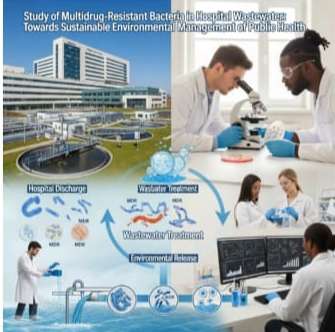
Study of Multidrug-Resistant Bacteria in Hospital Wastewater: Towards Sustainable Environmental Management of Public Health
Lecturer Dr. Hussein Abdul Ali Al-Har
The rapid rise of antimicrobial resistance (AMR) is considered a growing health issue around the world, and it is closely linked to the spread of AMR through wastewater [1]. This article delineates a comprehensive laboratory methodology for monitoring and identifying multidrug-resistant (MDR) bacteria in hospital wastewater systems. This article seeks to clarify the function of clinical effluents as reservoirs for resistance genes by combining modern microbiological assays with sustainability concepts. The study’s design aligns with the Sustainable Development Goals (SDGs) established by the United Nations. It helps attain Goal 3 (Good Health and Well-being) by stopping disease-carrying insects from spreading and Goal 12 (Responsible Consumption and Production) by training people how to properly throw away pharmaceutical and biological waste[2]. This suggestion makes it obvious that environmental microbiology should be a part of public health policy if we want healthcare systems to persist.
The advent of modern medicine has been paralleled by an exponential increase in the consumption of antimicrobial agents, a consequence of which is the emergence and selection of multidrug-resistant (MDR) microorganisms[3]. Hospital environments, and specifically their wastewater systems, serve as critical convergence points where high densities of pathogens, antimicrobial residues, and heavy metals coalesce. This creates an ideal selective pressure for horizontal gene transfer and the persistence of resistant strains [4].
Current wastewater treatment facilities often fail to remove all biological contaminants. The result means that MDR bacteria can end up in municipal rivers and then spread to the rest of the ecosystem. This spreading is a direct threat to SDG 3, which aims to ensure that everyone has a healthy life and promote well-being [5]. Furthermore, the uncontrolled discharge of these biological agents shows that SDG 12 has failed. This goal focuses on responsible consumption and production practices, especially when it comes to managing the lifetime of medicinal chemicals and waste. This article suggests a way to measure and describe this hazard, which could lead to better long-term management of the environment
Proposed Methodology
- Sample Collection and Processing
Wastewater samples will be taken from different places in a tertiary care hospital, such as the influent (raw sewage), effluent pre-treatment, and final discharge locations. Sampling will take place every two weeks for a year to account for changes in the use of antimicrobials and the number of pathogens that happen at different times of the year. Samples will be delivered in refrigerated conditions to the microbiology laboratory and processed within six hours of collection to preserve viability[6]. - Pathogen Isolation and Identification
Quantitative microbiological analysis will be conducted utilizing membrane filtration techniques and selective culture mediums, such as MacConkey agar for Enterobacteriaceae, Cetrimide agar for Pseudomonas aeruginosa, and Chromogenic MRSA agar for methicillin-resistant Staphylococcus aureus. We will use matrix-assisted laser desorption/ionization time-of-flight (MALDI-TOF) mass spectrometry to make sure that the isolates are correctly classified [7]. - Testing for Antimicrobial Susceptibility (AST)
To ascertain the prevalence of multidrug resistance, all detected isolates will be subjected to antimicrobial susceptibility testing in accordance with the Clinical and Laboratory Standards Institute (CLSI) standards. The disk diffusion method (Kirby-Bauer) will be utilized versus a selection of clinically significant antibiotics, encompassing beta-lactams, carbapenems, fluoroquinolones, and glycopeptides. Isolates that are resistant to at least one drug in three or more groups of antimicrobial drugs will be called MDR[8]. - Molecular Characterization To evaluate the genetic mobility of resistance determinants, phenotypically resistant isolates will be examined for the presence of extended-spectrum beta-lactamase genes (e.g., bla_CTX-M, bla_NDM) and carbapenemase genes (e.g., bla_KPC, bla_OXA-48) by polymerase chain reaction (PCR). Plasmid analysis can be performed to assess the capacity for horizontal gene transfer within the ambient microbiome[9].
Bridging Laboratory Findings with Sustainability Goals - Implications for SDG 3: Good Health and Well-being
Finding excessive levels of MDR bacteria in hospital wastewater is an early warning system for public health monitoring. The “One Health” approach says that the health of people, animals, and the environment are all connected[10]. We can find specific high-risk clones (like E. coli ST131) that might escape into the community by mapping the resistome (the collection of all resistance genes) in hospital wastewater[11]. This information is essential for creating infection prevention and control (IPC) policies that go beyond the hospital boundaries. This will help lower the number of hard-to-treat infections and help meet the goals of SDG 3.2. Implications for SDG 1[12]. - Responsible Consumption and Production
The results of this study directly tackle the unsustainable lifetime of antimicrobials and biological byproducts. The existence of resistant bacteria is associated with the quantity of antibiotics ingested and eliminated[13]. Thereby, hospital pharmacology committees can use laboratory data on resistance profiles to help Antimicrobial Stewardship Programs (ASP)[14]. By ensuring the optimal use of antibiotics, we reduce the selection pressure that leads to resistance. This study also shows that healthcare facilities need to use “green” wastewater technologies, like improved oxidation processes or membrane bioreactors, to be responsible in their output. It calls for a change in the way hospitals approach waste management, seeing it not only as disposal but as an important part of the healthcare delivery process.
The intersection of medical microbiology and environmental sustainability represents a critical frontier in modern public health. This proposed study provides a necessary scientific framework to quantify the flow of multidrug-resistant pathogens from clinical settings into the environment. By rigorously applying laboratory techniques to characterize these threats, we can develop evidence-based interventions that protect community health (SDG 3) and promote the responsible management of medical resources and waste (SDG 12). Ultimately, sustainable environmental management is not an addition to clinical practice but a fundamental requirement for preserving public health.n This article is structured to bridge the gap between clinical microbiology and the United Nations’ 2030 Agenda for Sustainable Development, focusing on the environmental impact of antimicrobial resistance (AMR)
Reference
- Sambaza SS, Naicker N. Contribution of wastewater to antimicrobial resistance: A review article. Journal of global antimicrobial resistance. 2023;34:23-9.
- Das T, Holland P, Ahmed M, Husain L, Ahmed M, Husain L. Sustainable development goal 3: Good health and well-being. South-East Asia Eye Health: Systems, Practices, and Challenges: Springer; 2021. p. 61-78.
- Muteeb G, Rehman MT, Shahwan M, Aatif M. Origin of antibiotics and antibiotic resistance, and their impacts on drug development: A narrative review. Pharmaceuticals. 2023;16(11):1615.
- Joshi DC, Prasad S, Sharma A, Joshi N. Pathological Contaminants in Wastewater from Hospital Waste: Implications and Mitigation Strategies. Emerging Contaminants in Water and Wastewater: Sources and Substances: Springer; 2025. p. 43-85.
- Riya JFI. Sustainable Development Goals (SDGs) and antibiotic resistance: the need to search beyond: Brac University; 2021.
- Addae-Nuku DS. Multidrug-Resistant Bacteria In Hospital Wastewater Of The Korle Bu Teaching Hospital: University Of Ghana; 2022.
- Kricka LJ. New technologies for microbiological assays. Rapid Microbiological Methods in the Pharmaceutical Industry. 2003:157.
- Tilahun M. Multi-drug resistance profile, prevalence of extended-spectrum beta-lactamase and carbapenemase-producing gram negative bacilli among admitted patients after surgery with suspected of surgical site nosocomial infection north east Ethiopia. Infection and Drug Resistance. 2022:3949-65.
- Igweonu CF. Molecular characterization of antibiotic resistance genes in multidrug-resistant Klebsiella pneumoniae clinical isolates. Int J Eng Technol Res Manag. 2024;8(08):241.
- Al-Khalaifah H, Rahman MH, Al-Surrayai T, Al-Dhumair A, Al-Hasan M. A One-Health Perspective of Antimicrobial Resistance (AMR): Human, Animals and Environmental Health. Life. 2025;15(10):1598.
- Puljko A, Babić I, Rozman SD, Barišić I, Jelić M, Maravić A, et al. Treated municipal wastewater as a source of high-risk and emerging multidrug-resistant clones of E. coli and other Enterobacterales producing extended-spectrum β-lactamases. Environmental research. 2024;243:117792.
- Oliveira M, Antunes W, Mota S, Madureira-Carvalho Á, Dinis-Oliveira RJ, Dias da Silva D. An overview of the recent advances in antimicrobial resistance. Microorganisms. 2024;12(9):1920.
- Schjørring S, Krogfelt KA. Assessment of bacterial antibiotic resistance transfer in the gut. International journal of microbiology. 2011;2011(1):312956.
- Stenehjem EA, Braun BI, Chitavi SO, Hyun DY, Schmaltz SP, Fakih MG, et al. Use of leading practices in US hospital antimicrobial stewardship programs. Infection Control & Hospital Epidemiology. 2023;4د4(6):861-8.