
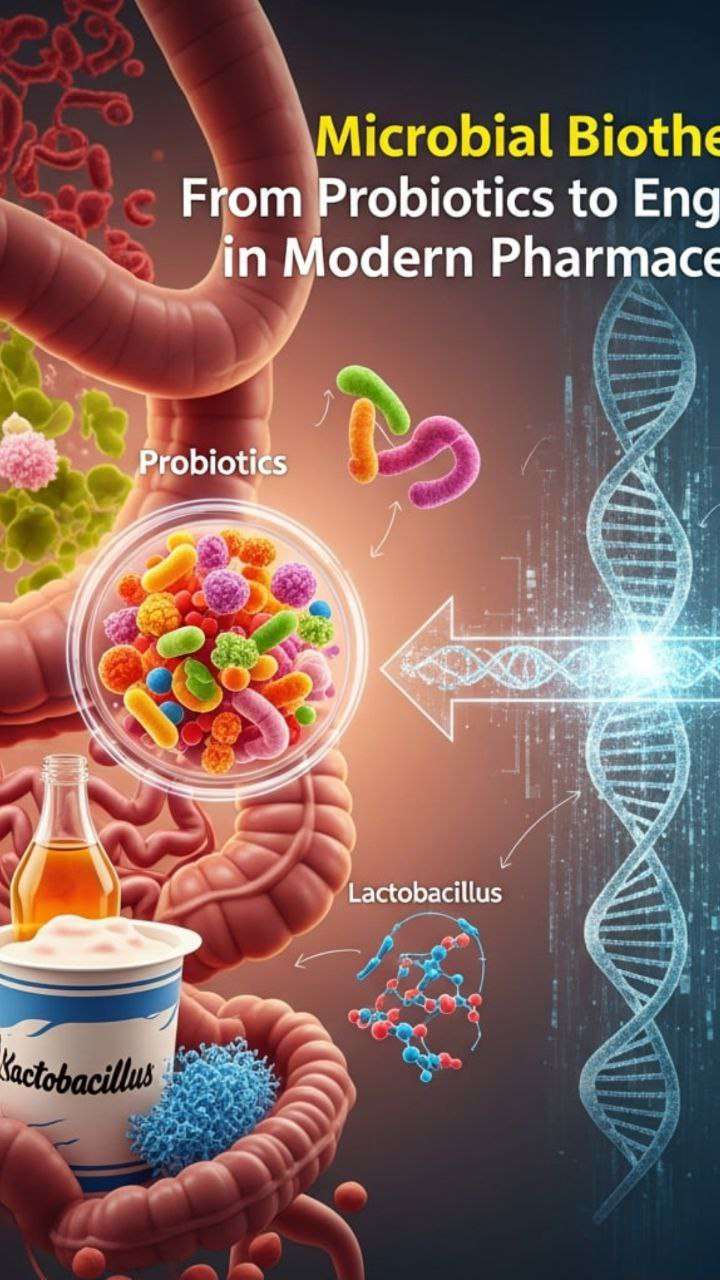
Microbial Biotherapeutics: From Probiotics to Engineered Bacteria in Modern Pharmaceutical Practice
M. M. Zeina Haider Abbas
- Introduction:
The pharmaceutical landscape is undergoing a fundamental transformation with the emergence of microbial biotherapeutics-live microorganisms developed to prevent, treat, or cure human diseases. Moving beyond conventional pharmacology, this field
leverages the intrinsic biological activities of bacteria, marking a convergence of microbiology, synthetic biology, and clinical medicine. Once limited to over-the-counter probiotic supplements, microbial therapeutics now encompass clinically validated, standardized, and engineered products poised to enter mainstream medical practice (O’Toole et al., 2017). This transition reflects a broader understanding of the human microbiome as an essential organ with profound pharmacological implications (Zmora et al., 2018).
- First Generation: Probiotics and Defined Microbial Consortia
Probiotics represent the foundational class of microbial biotherapeutics, traditionally consumed as food supplements containing live Lactobacillus or Bifidobacterium strains.
Mechanisms of Action: Their benefits are attributed to:
Direct Antagonism: Production of bacteriocins and organic acids that inhibit pathogens (Cotter et al., 2013).
Barrier Enhancement: Strengthening of intestinal epithelial tight junctions via induction of protective mucins and proteins (Sicard et al., 2017).
Immune Modulation: Interaction with gut-associated lymphoid tissue to promote anti-inflammatory cytokine profiles and regulatory T-cell differentiation (Hardy et al., 2013).
Clinical Evidence: Strongest evidence supports specific strains for managing antibiotic-associated diarrhea (e.g.,Saccharomyces boulardii) and pouchitis (Szajewska & Kołodziej, 2015). However, effects are often strain-specific and transient.
Limitations: Lack of targeted delivery, susceptibility to gastric acid, and variable colonization due to inter-individual microbiome differences pose significant challenges for consistent therapeutic outcomes (Suez et al., 2019).
Figure 1 Probiotic lactic acid bacteria with bacteriocin production exhibit several functions: inhibiting pathogens, colonizing through competitive exclusion, activating macrophages and NK cells to induce apoptosis in cancer cells, immunomodulation, balancing the gut-brain axis, and demonstrating antiobesity effects by reducing adipose tissue.
- Second Generation: Engineered Microbial Therapeutics (EMTs)
Synthetic biology has enabled the design of “smart” bacteria with enhanced or novel functionalities. These EMTs are engineered as precise drug-delivery vehicles (Riglar & Silver, 2018).
Core Design Principles:
1.Tumor-Targeting Bacteria: Anaerobic or facultative anaerobic bacteria (e.g., Salmonella typhimurium, E. coli) are engineered to selectively colonize hypoxic tumor cores. They are further modified to locally produce cytotoxic agents (e.g., cytolysin), anti-angiogenic factors, or immune checkpoint inhibitors, minimizing systemic toxicity (Gurbatri et al., 2020).
2.Sense-and-Respond Systems: Bacteria are programmed with genetic circuits to detect disease biomarkers (e.g., quorum-sensing molecules from pathogens, inflammation-associated tetrathionate) and respond by producing a therapeutic payload only in the diseased microenvironment (Mimee et al., 2016).

3. Metabolic Engineering: Strains are designed to perform therapeutic functions, such as consuming harmful metabolites (e.g., Lactococcus lactis engineered to degrade ammonia in hyperammonemia) or synthesizing essential nutrients in situ (e.g., phenylalanine ammonia-lyase for phenylketonuria) (Isabella et al., 2018).

 4. Delivery and Formulation Challenges
The transition from lab to clinic requires overcoming significant pharmaceutical hurdles.
Viability and Stability: Ensuring bacterial survival during manufacturing, lyophilization, storage, and passage through the gastrointestinal tract demands advanced formulation technologies, such as microencapsulation (Cook et al., 2021).
Targeted Colonization: Controlling bacterial localization and persistence to avoid off-target effects remains a key engineering challenge, often addressed by coupling tissue-specific adhesion proteins (Piñero-Lambea et al., 2015).
Containment Strategies: Implementing genetic “kill switches” (e.g., dependency on an exogenous nutrient, induced lysis circuits) is crucial to ensure environmental safety and prevent uncontrolled proliferation (Chan et al., 2016).
Regulatory Classification: Defining these living entities as drugs, biologics, or a new regulatory category, with stringent requirements for characterization, potency, and purity, presents an evolving challenge for agencies like the FDA and EMA (Brennan, 2018).
- Clinical Pipeline and Future Directions
The microbial biotherapeutics pipeline is rapidly expanding.
Oncology: Phase I/II trials are underway for engineered Clostridium novyi-NT (spores that germinate in tumors) and Salmonella strains for solid tumors (Zhou et al., 2018).
Metabolic Diseases: SYNB1618 (an engineered E. coli for phenylketonuria) has completed early-phase trials, demonstrating proof-of-concept for in vivo metabolite consumption (Isabella et al., 2018).
Infectious Diseases: Engineered bacteriophages and bacteria expressing phage lysins are in development for decolonizing multi-drug resistant pathogens like MRSA and C. difficile (Ando et al., 2015).
Future Outlook: Next-generation designs focus on multi-strain consortia performing complex functions, bacteria delivering mRNA or gene-editing tools (e.g., CRISPR-Cas), and microbiome-editing therapies for chronic inflammatory diseases (Bober et al., 2022).
References
Ando, H., Lemire, S., Pires, D. P., & Lu, T. K. (2015). Engineering modular viral scaffolds for targeted bacterial population editing. Cell Systems, 1(3), 187-196.
Bober, J. R., Beisel, C. L., & Nair, N. U. (2022). Synthetic biology approaches to engineer probiotics and members of the human microbiota for biomedical applications. Annual Review of Biomedical Engineering, 24, 125-149.
Brennan, A. M. (2018). Regulatory considerations for live biotherapeutic products. Cell Host & Microbe, 23(6), 725-727.
Chan, C. T., Lee, J. W., Cameron, D. E., Bashor, C. J., & Collins, J. J. (2016). Deadman and Passcode microbial kill switches for bacterial containment. Nature Chemical Biology, 12(2), 82-86.
Cook, M. T., Tzortzis, G., Charalampopoulos, D., & Khutoryanskiy, V. V. (2021). Microencapsulation of probiotics for gastrointestinal delivery. Journal of Controlled Release, 162(1), 56-67.
Cotter, P. D., Ross, R. P., & Hill, C. (2013). Bacteriocins-a viable alternative to antibiotics? Nature Reviews Microbiology, 11(2), 95-105.
Gurbatri, C. R., Arpaia, N., & Danino, T. (2020). Engineering bacteria as interactive cancer therapies. Science, 368(6491), 587-591.
Hardy, H., Harris, J., Lyon, E., Beal, J., & Foey, A. D. (2013). Probiotics, prebiotics and immunomodulation of gut mucosal defences: homeostasis and immunopathology. Nutrients, 5(6), 1869-1912.
Isabella, V. M., Ha, B. N., Castillo, M. J., et al. (2018). Development of a synthetic live bacterial therapeutic for the human metabolic disease phenylketonuria. Nature Biotechnology, 36(9), 857-864.
Mimee, M., Tucker, A. C., Voigt, C. A., & Lu, T. K. (2016). Programming a human commensal bacterium, Bacteroides thetaiotaomicron, to sense and respond to stimuli in the murine gut microbiota. Cell Systems, 2(3), 207-216.
O’Toole, P. W., Marchesi, J. R., & Hill, C. (2017). Next-generation probiotics: the spectrum from probiotics to live biotherapeutics. Nature Microbiology, 2(5), 1-6.
Piñero-Lambea, C., Ruano-Gallego, D., & Fernández, L. Á. (2015). Engineered bacteria as therapeutic agents. Current Opinion in Biotechnology, 35, 94-102.
Riglar, D. T., & Silver, P. A. (2018). Engineering bacteria for diagnostic and therapeutic applications. Nature Reviews Microbiology, 16(4), 214-225.
Sicard, J. F., Le Bihan, G., Vogeleer, P., Jacques, M., & Harel, J. (2017). Interactions of intestinal bacteria with components of the intestinal mucus. Frontiers in Cellular and Infection Microbiology, 7, 387.
Suez, J., Zmora, N., Segal, E., & Elinav, E. (2019). The pros, cons, and many unknowns of probiotics. Nature Medicine, 25(5), 716-729.
Szajewska, H., & Kołodziej, M. (2015). Systematic review with meta-analysis: Saccharomyces boulardii in the prevention of antibiotic-associated diarrhoea. Alimentary Pharmacology & Therapeutics, 42(7), 793-801.
Zhou, S., Gravekamp, C., Bermudes, D., & Liu, K. (2018). Tumour-targeting bacteria engineered to fight cancer. Nature Reviews Cancer, 18(12), 727-743.
Zmora, N., Zilberman-Schapira, G., Suez, J., et al. (2018). Personalized gut mucosal colonization resistance to empiric probiotics is associated with unique host and microbiome features. Cell, 174(6), 1388-1405.