
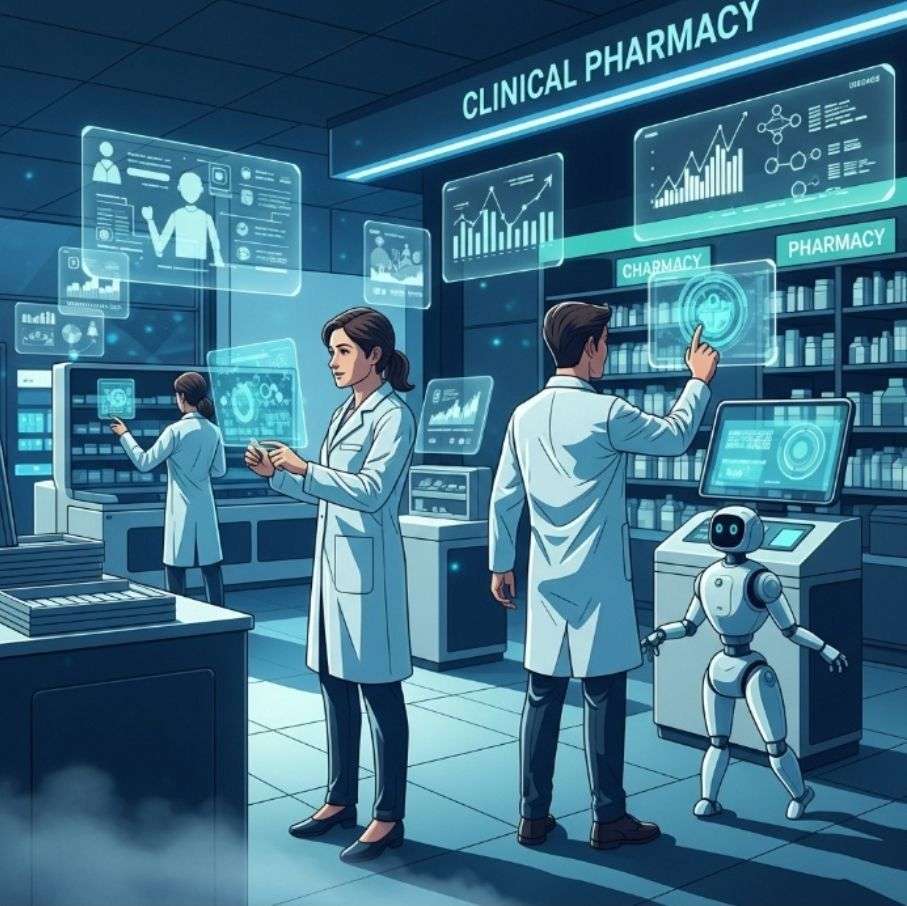
The Future of Clinical Pharmacy in Modern Healthcare Systems
M.M. Hanin Hussein Farhoud
Department of Clinical Pharmacy, College of Pharmacy, University of Karbala
The development of clinical pharmacy is witnessing a qualitative shift in modern healthcare systems, with an increasing focus on improving patient outcomes, reducing medication errors, and enhancing integration between the clinical pharmacist and the rest of the healthcare team. Studies show that clinical pharmacist interventions lead to improved clinical metrics such as reduced medication errors and shorter hospital stays. Emerging research also supports the use of AI-based predictive tools to identify medication risks and reduce the human burden in therapeutic interventions.
However, there are challenges related to raising awareness of the pharmacist’s role and integrating them into daily clinical decision-making. This article explores the future of clinical pharmacy, focusing on the most important trends, identifying research limitations and gaps, and proposing future research directions.
- Scientific Background and Clinical Pharmacy in Healthcare Systems
Clinical pharmacy refers to the provision of pharmacist services in direct patient care, including medication review, drug interaction screening, treatment counseling, and contributing to treatment decision-making. Studies show that clinical pharmacist interventions in hospitals lead to better health outcomes, such as reduced medication errors and medication-related problems, reflecting the value of this role in modern healthcare systems.1
Recent studies include: evaluations of clinical pharmacy services, where meta-analyses have shown that including a clinical pharmacist in the care team reduces medication errors, contributes to appropriate treatment selection, and leads to lower hospital readmission rates.1 Also included are the use of computational predictions, such as machine learning tools, to improve medication safety and early detection of drug interaction risks.2 Furthermore, there are the perspectives of healthcare professionals and the public on the role of pharmacists and whether it is adequately understood, highlighting the need to raise awareness of this profession’s role.3 The perceptions of pharmacists themselves and the impact of training and experience on their understanding of their clinical tasks within the healthcare system are also examined.4 Finally, the role of medication management programs in the community and their importance in promoting patient well-being and reducing complications of chronic diseases are explored.5
- Key Concepts and Research Insights
- Improving Patient Outcomes and Treatment Safety: A key focus is the role of the clinical pharmacist in improving the quality of medication therapy. According to an evaluation study involving clinical pharmacists’ interventions in medication review, these interventions contribute to reducing high-risk errors, improving dosage selection, and shortening hospital stays, demonstrating a tangible impact on clinical and patient performance.1 This role underscores that clinical pharmacists’ responsibilities extend beyond simply dispensing medications; they encompass comprehensive medication management.
- Artificial Intelligence and Decision Support: Research has also explored the potential of using machine learning and decision support systems to assist clinical pharmacists in identifying high-risk medication-related conditions. These machine learning tools provide a layer of predictive analysis that enhances pharmacist efficiency and reduces human error, opening new horizons in technology-enhanced clinical pharmacy.2
- Role Perceptions and Integration within the Healthcare Team: It is also important to understand how clinical pharmacists perceive their role and how they are viewed by clinicians and patients.
٤. A survey indicates a disparity in perception between healthcare professionals and the general public, highlighting the need for improved communication and public awareness of the role of clinical pharmacy.3 - Precision Medicine in Clinical Pharmacy Practice
3.1 Utilizing Electronic Health Records in Pharmacogenetics
Integrating genetic data with electronic health records represents a new frontier in clinical pharmacy. In a study published in Nature Communications in March 2025, researchers used data from the UK Biobank and the US All of Us program to investigate the genetic basis of response to cardiometabolic drugs.
The study included 41,732 participants from the UK Biobank and 14,277 from the All of Us program, and focused on ten measures of drug response, including lipid response to statins, HbA1c response to metformin, and blood pressure response to antihypertensive drugs. The researchers were able to recover previously known gene-based drug signaling pathways at the genome-wide level, such as the APOE, LPA, and SLCO1B1 genes. They also discovered a novel association of a rare gene variant in the GIMAP5 gene with HbA1c response to metformin.
Clinically, these associations were treatment-specific and were not associated with the development of biomarkers in untreated individuals.6 This suggests that the identified genetic markers reflect a specific drug response rather than simply the natural course of the disease. Although the polymorphic genetic risk scores predicted drug response, they explained less than 2% of the observed variance, highlighting the complexity of gene-drug interactions and the need for more comprehensive models.
3.2 Future Prospects for Precision Pharmacy
These findings open new avenues for clinical pharmacy. Clinical pharmacists could potentially use patients’ genetic information to personalize treatments, selecting the appropriate drug and dosage based on the individual’s genetic profile. However, there is still a long way to go; the limited explanation of the variance (less than 2%) indicates that genetic factors alone are insufficient for accurate prediction of response, and that the interaction with environmental and lifestyle factors plays a crucial role.
Studies agree that clinical pharmacy contributes to improved treatment safety and health outcomes.1 The importance of training and education is also emphasized: there is agreement that undergraduate and continuing education enhances understanding of roles and improves pharmacist performance.4 AI predictions are meant to support, not replace: while some studies view modern technology as a support, no recent studies advocate replacing pharmacists with these systems, but rather enhancing their role.2
However, studies differ on the extent of integration within the healthcare team: while some studies highlight the importance of collaboration between pharmacists and physicians, assessments of physicians’ and the public’s understanding of pharmacists’ roles reveal discrepancies, indicating a gap in awareness and genuine integration.3
Despite these advances, several limitations and research gaps exist, including a scarcity of long-term, multicenter studies that comprehensively measure the impact of clinical pharmacy on population health levels. The primary focus is on hospital settings, while clinical pharmacy in primary and community care has not been studied with the same depth in Nature publications. There is also a lack of studies evaluating the optimal approach to integrating AI into daily practice in a way that ensures safe outcomes while adhering to ethical standards. These gaps highlight the need for future research aimed at developing more comprehensive assessment models and analyzing the role of pharmacists in diverse healthcare settings.
Based on the literature published in Nature to date, promising research directions include: long-term evaluation of the effectiveness of clinical pharmacy in improving health outcomes at the population level; integrating artificial intelligence (AI) into decision support systems and assessing its impact on pharmacist performance through pilot studies; enhancing inclusion within multidisciplinary healthcare teams through research evaluating educational and training strategies; and studies on public perceptions and their role in promoting the acceptance of clinical pharmacy services within healthcare communities.
Conclusion
Given the current developments in modern healthcare systems, the literature published in Nature clearly demonstrates that clinical pharmacy plays a pivotal role in improving the quality of healthcare and patient safety. Studies confirm that clinical pharmacist interventions lead to positive outcomes and reduced treatment risks, and they show that modern technologies, particularly AI, provide significant support for enhancing clinical practice performance. However, awareness of the pharmacist’s role and full integration within the healthcare team still require improvement. Therefore, the future remains promising if research is directed toward bridging current gaps and expanding the scope of application in diverse healthcare settings.
In conclusion, the future of clinical pharmacy is not about replacing pharmacists with machines, but rather about empowering pharmacists with advanced tools that enable them to provide more precise, safer, and more effective care.
The fundamental challenge is not so much technical as it is human and institutional: how do we redesign pharmacy education, professional practice, and health policies to accommodate these transformations and harness them to serve patients?
References
(1) Social, D.; Bektay, M. Y.; Acikgoz, N.; Izzettin, F. V. Evaluation of Clinical Pharmacy Services in Patients Receiving Antithrombotic Treatment in a Randomized Controlled Trial. Sci Rep 2025, 15 (1), 41692. https://doi.org/10.1038/s41598-025-25594-0.
(2) Abdo, A.; Gallay, L.; Vallecillo, T.; Clarenne, J.; Quillet, P.; Vuiblet, V.; Merieux, R. A Machine Learning-Based Clinical Predictive Tool to Identify Patients at High Risk of Medication Errors. Sci Rep 2024, 14 (1), 32022. https://doi.org/10.1038/s41598-024-83631-w
(3) Horio, F.; Ikeda, T.; Kouzaki, Y.; Hirahara, T.; Masa, K.; Narita, S.; Tomita, Y.; Tsuruzoe, S.; Fujisawa, A.; Akinaga, Y.; Ashizuka, Y.; Inoue, Y.; Unten, A.; Okamura, K.; Takechi, Y.; Takenouchi, Y.; Tanaka, F.; Masuda, C.; Sugimura, Y.; Uchida, Y. Questionnaire Survey on Pharmacists’ Roles among Non- and Health Care Professionals in Medium-Sized Cities in Japan. Sci Rep 2023, 13 (1), 5458. https://doi.org/10.1038/s41598-023-32777-0.
(4) Farajallah, A.; Zainal, H.; Palaian, S.; Alomar, M. A National Survey on Assessment of Knowledge, Perceptions, Practice, and Barriers among Hospital Pharmacists towards Medication Reconciliation in United Arab Emirates. Sci Rep 2024, 14 (1), 15370. https://doi.org/10.1038/s41598-024-64605-4.
(5) Albabtain, B.; Bawazeer, G.; Paudyal, V.; Cheema, E.; Alqahtani, A.; Bahatheq, A.; Price, M. J.; Hadi, M. A. Impact of a Community Pharmacy-Based Medication Therapy Management Program on Clinical and Humanistic Outcomes in Patients with Uncontrolled Diabetes: A Randomised Controlled Trial. Sci Rep 2024, 14 (1), 17818. https://doi.org/10.1038/s41598-024-65759-x.
(6) Sadler, M. C.; Apostolov, A.; Cevallos, C.; Auwerx, C.; Ribeiro, D. M.; Altman, R. B.; Kutalik, Z. Leveraging Large-Scale Biobank EHRs to Enhance Pharmacogenetics of Cardiometabolic Disease Medications. Nat Commun 2025, 16 (1), 2913. https://doi.org/10.1038/s41467-025-58152-3.