
perovskite Nanomaterials in Biomedical applications
Nada. Y. Fairooz
Abstract
Perovskite materials with the general formula ABX₃ have attracted considerable scientific and technological interest due to their exceptional structural flexibility and wide range of functional properties. This article reviews the fundamental thermodynamic principles governing perovskite stability, including phase transitions and the role of tolerance factors in determining structural symmetry. Particular emphasis is placed on fractionally doped perovskite oxides (FDPOs), where partial cation substitution enables precise tuning of physical and chemical properties for targeted applications. Recent advances in machine learning–assisted materials discovery are discussed as effective approaches for navigating the vast compositional space of FDPOs, with demonstrated high predictive accuracy in identifying stable and application-specific compounds. Furthermore, the role of nano-engineered core/shell architectures in enhancing environmental stability and functional performance is highlighted, especially in energy conversion and sensing technologies. Collectively, these developments underscore the potential of integrating thermodynamic understanding, data-
driven design, and nano-engineering strategies to accelerate the development of next-generation perovskite-based materials for energy, electronic, and biomedical applications.
- Introduction
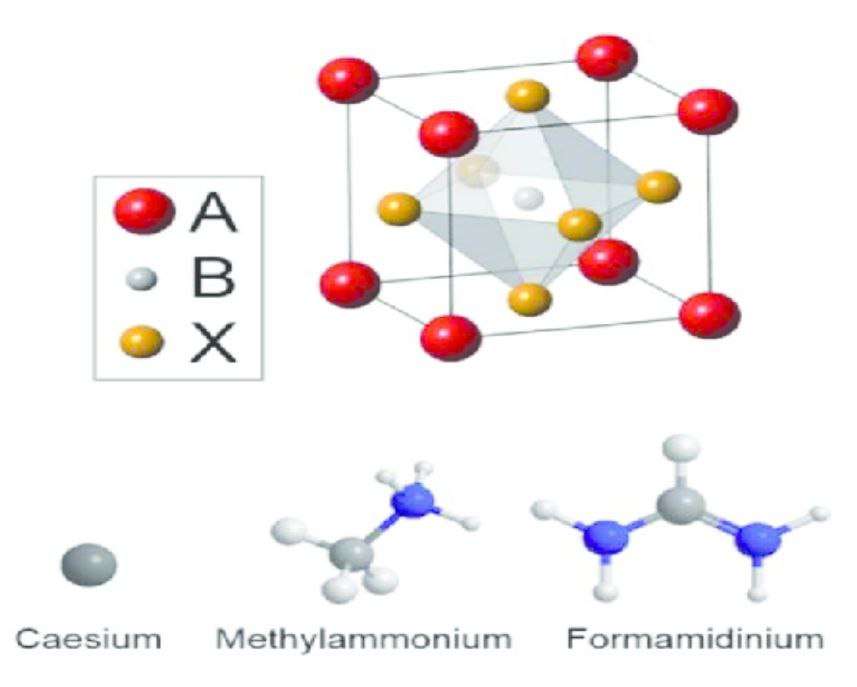
The perovskite crystal structure, named after the Russian mineralogist Lev Perovski, is a highly versatile and widely studied framework in materials science. It is commonly represented by the general formula ABX₃, where the A-site is occupied by a large cation located at the corners of the unit cell, the B-site contains a smaller cation at the center[1], and the X-site consists of anions—typically oxygen or halides—forming an octahedral coordination around the B-site cation. This structural arrangement allows extensive elemental substitution, enabling precise tuning of physical and chemical properties. [2]
As a result of this compositional flexibility, fractionally doped perovskite oxides (FDPOs) have found broad applications in energy conversion and storage, catalysis, sensing, superconductivity, ferroelectric and piezoelectric devices, as well as magnetic and luminescent systems. However, the enormous compositional space created by partial doping makes conventional experimental discovery approaches inefficient and costly.[3]
To overcome this limitation, machine learning has emerged as an effective strategy for accelerating materials discovery. A function-confined machine learning methodology was recently developed to identify new FDPO compositions with high accuracy from limited experimental data, focusing on solar thermochemical hydrogen production. Using 632 training samples and 21 material descriptors, a gradient boosting classifier achieved a prediction accuracy of 95.4% and an F1 score of 0.921, with further validation yielding 94.4% accuracy. This approach led to the discovery and synthesis of 11 new FDPOs,
seven of which are promising for hydrogen production, demonstrating the potential of data-driven methods in guiding targeted perovskite materials design.[4]
1.1 Physical Properties, Thermodynamics, and Structural Stability of Perovskites :
The physical stability and symmetry of the perovskite crystal structure are fundamentally governed by thermodynamic principles and phase behavior. One of the most widely used parameters to evaluate structural stability is the Goldschmidt tolerance factor (t) , which correlates the ionic radii of the A-site cation, B-site cation, and X-site anion. For an ideal cubic perovskite structure, the tolerance factor approaches unity (t ≈ 1.0) [5] .
Deviations from this ideal value induce lattice distortions, leading to lower-symmetry phases such as tetragonal or orthorhombic structures, which in turn significantly influence electronic, dielectric, and mechanical properties.
A defining thermodynamic characteristic of perovskites is their high vibrational entropy , which contributes to remarkable stability under extreme pressure and temperature conditions. Mineralogical studies, notably those reported by Navrotsky (1998), demonstrate that silicate perovskites dominate the Earth’s lower mantle due to their thermodynamic favorability at high-pressure environments [6] . In addition to structural robustness, many oxide perovskites exhibit )ferroelectric behavior(, characterized by spontaneous electric polarization. A classic example is barium titanate (BaTiO₃), which plays a critical role in capacitors, non-volatile memory devices, and electromechanical systems due to its strong dielectric response and phase-transition-driven polarization. [7]
Fig. 1: Thermodynamics and nano-engineering of fractionally doped perovskite ABX₃.
1.2 Fractionally Doped Perovskites, Nano-Engineering, and Future Applications:
Perovskite materials derived from the mineral of CaTiO3 have the general formula ABX3, in which A and B are cations, and X is an anion. Perovskites have a typical crystal structure shown in Fig. 1. The smaller B-site cation has six-fold coordination and forms a BX6 octahedron. Eight BX6 octahedra share corners to form a dodecahedron interstitial space for accommodating a twelve-fold coordinated larger A-site cation. The X is usually an oxygen, halogen or chalcogen anion, which can tolerate many vacancies. Perovskites have demonstrated ubiquitous applications to energy conversion/storage/harvesting, catalysis, sensor, superconductor, ferroelectric, piezoelectric, magnetic, and luminescence due to the numerous unique prop erties caused by their versatile compositions and flexible crystal structure symmetries. Hybrid organic-inorganic perovskites (HOIPs) and inorganic perovskites (IPs) are the two main perovskites. HOIPs have a positively charged organic group (e.g., methylammonium, MA; formamidinium, FA) in A site, a metal cation (e.g., Pb,
Sn) in B site, and a halogen anion (e.g., I, Cl, Br) in X site1. As semiconductors, HOIPsshowedexcellent optical and electrical properties and found extensive applications to solar cells2–5, photodetectors [8] , photocatalysis [9], and light-emitting8. IPs usually denote perovskites oxides with metal cations in A and B sites and oxygen anions in the X site. Perovskite oxides allow fractionally doping multiple metals in both A and B sites and forming crystal structures with ~15 symmetries, enabling almost infinite compositions with unique properties. Instead of the simple ABO3 perovskite oxides, the fractionally doped perovskite oxides (FDPOs) with a generic for mula of A1 x1 A2 x2 Am xm B1 y1 B2 y2 Bn yn O3 (Am and Bn are metal cations, m ≥1, n≥1, x1+x2+…xm=1, y1+y2+…yn=1)have demonstrated pervasive applications. Mn and Sr dopedLaAlO3 was the first experimentally proved perovskite oxide to efficiently split water and carbon dioxide to produce hydrogen and carbon mon oxide based on the high-temperature and low-temperature solar thermochemical redox cycles[10]. Ba0.5Sr0.5Co0.8Fe0.2O3-δ showed extremely high performance as an oxygen-permeable membrane and the cathode of oxygen-ion conducting solid oxide fuel cells (O SOFCs)[11,12] . Perovskite oxides of BaCe0.7Zr0.1Y0.1Yb0.1O3-δ and BaCo0.4Fe0.4Zr0.1Y0.1O3-δ demonstrated promising performance as an electrolyte and an oxygen electrode for protonic ceramic fuel/ electrolysis cells (PCFCs and PCECs)[13,14] .
Reference
Department of Materials Science and Engineering, Clemson University, Clemson, SC, USA.
School of Computing, Clemson University, Clemson, SC, USA.
These authors contributed equally: Ximei Zhai, Fei Ding. ✉email: luofeng@clemson.edu; jianhut@clemson.edu
Kong, H., & Wong, J. Y. (2014). Materials for biological modulation, sensing, and imaging. MRS Bulletin, 39(1), 68-73. https://doi.org/10.1557/mrs.2013.317
Navrotsky, A. (1998). Energetics and Crystal Chemical Systematics among Ilmenite, Lithium Niobate, and Perovskite Structures. Chemistry of Materials, 10(10), 2787-2793. https://doi.org/10.1021/cm9801901
Zhai, X., Ding, F., Zhao, Z., Santomauro, A., Luo, F., & Tong, J. (2022). Predicting the formation of fractionally doped perovskite oxides by a function-
confined machine learning method. Communications Materials, 3(42), 1-10. https://doi.org/10.1038/s43246-022-00269-9
Akaogi, M., & Navrotsky, A. (1985). Calorimetric determination of the enthalpies of phase transitions in the system MgGeO_3. Physics and Chemistry of Minerals, 12(6), 317-323.
Yuan, Z. et al. One-dimensional organic lead halide perovskites with efficient bluish white-light emission. Nat. Commun. 8, 109202 (2017).
McDaniel, A. H. et al. Sr- and Mn-doped LaAlO3-δ for solar thermochemical H2 and CO production. Energy Environ. Sci. 6, 2424–2428 (2013).
Shao, Z. et al. Investigation of the permeation behavior and stability of a Ba0.5Sr0.5Co0.8Fe0.2O(3-δ) oxygen membrane. J. Memb. Sci. 172, 177–188 (2000).
Shao, Z. & Haile, S. M. A high-performance cathode for the next generation of solid-oxide fuel cells. Mater. Sustain. Energy A Collect. Peer-Reviewed Res. Rev. Artic. from Nat. Publ. Gr 3, 255–258 (2010).
Zhu, H., Ricote, S., Duan, C., O’Hayre, R. P. & Kee, R. J. Defect chemistry and transport within dense BaCe0.7Zr0.1Y0.1Yb0.1O3−δ(BCZYYb) proton conducting membranes. J. Electrochem. Soc. 165, F845–F853 (2018).
Xia, C. et al. Shaping triple-conducting semiconductor BaCo0.4Fe0.4Zr0.1Y0.1O3-δ into an electrolyte for low-temperature solid oxide fuel cells. Nat. Commun. 10,1–9 (2019).
Morales, M. et al. Correlation between electrical and mechanical properties in La1-xSrxGa1-yMgyO3-δ ceramics used as electrolytes for solid oxide fuel cells. J. Power Sources 246, 918–925 (2014).