
The Human Microbiome and Precision Pharmacy: Towards Personalized Therapies in the Post-Antibiotic Era
M.M :Zeina Haider Abbas
Summary
The escalating crisis of antimicrobial resistance (AMR) necessitates a paradigm shift in therapeutic strategies. Precision microbiome-based therapeutics, which target the human microbiome the vast ecosystem of commensal microorganisms inhabiting our bodies have emerged as a promising avenue for personalized medicine in the post-antibiotic era. This detailed academic review synthesizes evidence exclusively from the Nature family of journals, demonstrating that targeted modulation of the microbiome, through next-generation probiotics, faecal microbiota transplantation (FMT), and microbe-derived metabolites, can effectively treat conditions ranging from recurrent Clostridioides difficile infection to cancer and metabolic disorders. We discuss foundational mechanisms, recent clinical evidence, and the inherent challenges in standardizing and regulating these complex living drugs. The conclusion outlines a future research agenda integrating multi-omics and rigorous clinical trials to realize the full potential of microbiome-informed precision pharmacy.
- Introduction
The human microbiome constitutes a complex, dynamic community of bacteria, archaea, fungi, and viruses that exist in symbiosis with the host. It is now recognized as a virtual endocrine organ, integral to host physiology, metabolism, and immunity (Lynch & Pedersen, 2016). The advent of high-throughput sequencing has catalysed the understanding that a disruption in microbial homeostasis, termed dysbiosis, is implicated in a vast array of diseases beyond the gut, including cancer, autoimmune disorders, and neurological conditions. Concurrently, the diminishing returns of broad-spectrum antibiotics have created an urgent need for novel, targeted antimicrobial strategies. This confluence has given rise to the field of microbiome-based precision pharmacy, which seeks to develop diagnostic and therapeutic interventions tailored to an individual’s microbial composition to maximize efficacy and minimize collateral damage to the commensal microbiota.
- Foundational Mechanisms and Concepts
Therapeutic strategies targeting the microbiome are predicated on several key functional mechanisms:
1. Metabolite-Mediated Signaling: Commensal microbes ferment dietary fibers to produce short-chain fatty acids (SCFAs) like butyrate, propionate, and acetate. Butyrate, for instance, serves as a primary energy source for colonocytes and exerts potent anti-inflammatory and immunomodulatory effects by influencing regulatory T-cell (Treg) differentiation and function (Arpaia et al., 2013). Therapies can aim to boost the production of such beneficial metabolites.
- Host Immune System Modulation: The microbiome is fundamental to the education and regulation of the host immune system. It influences the balance between pro-inflammatory and anti-inflammatory responses. This interaction is the cornerstone of how the gut microbiome can modulate responses to cancer immunotherapy, such as immune checkpoint inhibitors (ICIs) (Routy et al., 2018).
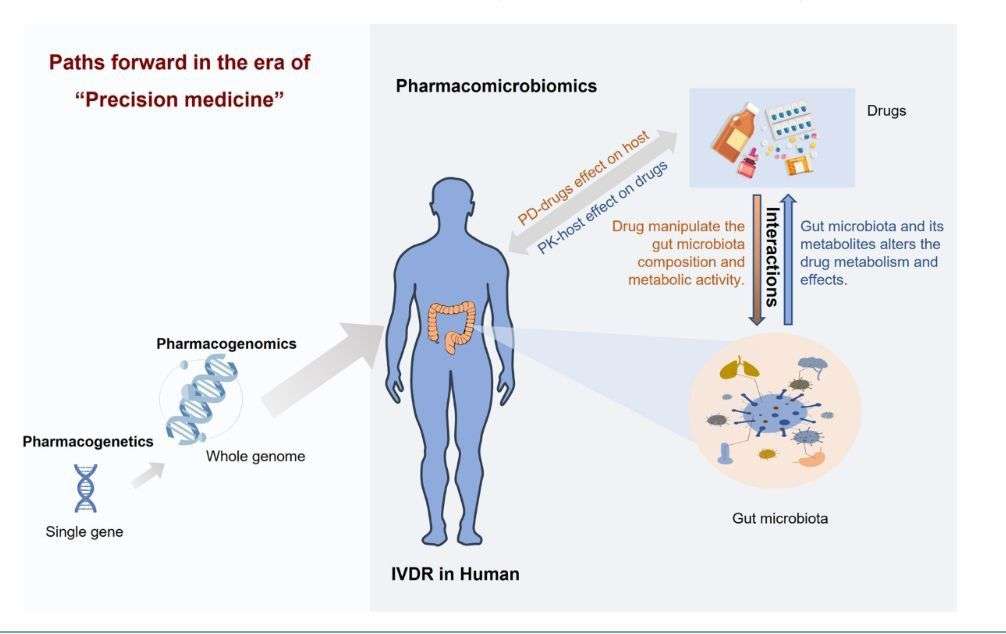
4. Xenobiotic Metabolism: The microbiome directly metabolizes a wide range of pharmaceutical compounds, altering their bioavailability, efficacy, and toxicity. This “pharmacomicrobiomics” presents an opportunity for personalized drug dosing and selection (Zimmermann et al., 2019) Figure 1.
Figure 1: Drug-microbiota interactions: an emerging priority for precision medicine (Zhao et al., 2023)
- Recent Findings and Studies:
3.1 Microbiome Restoration for Infectious Disease
Recurrent Clostridioides difficile infection (rCDI) represents the archetypal success story for microbiome-based therapy. While FMT from a healthy donor has proven highly effective, its limitations-including variability, lack of standardization, and safety concerns-have driven research towards defined microbial consortia. A pivotal study published in Nature Medicine demonstrated the efficacy of SER-109, an
investigational microbiome therapeutic composed of purified Firmicutes spores, in preventing rCDI (Feuerstadt et al., 2022).
3.2 Modulating Cancer Immunotherapy Response
Seminal work has established a strong association between gut microbiome composition and the efficacy of ICIs like anti-PD-1/PD-L1 agents.. Gopalakrishnan et al. (2018) and Matson et al. (2018), identified specific bacterial taxa (e.g., Faecalibacterium spp.) enriched in responders. Crucially, a landmark study by Routy et al. (2018) showed that faecal microbiota transplantation from ICI-responding patients into germ-free mice could transfer the therapeutic benefit, while administration of antibiotics abrogated response in both mice and human patients. Subsequent mechanistic work in Nature has revealed that microbial-derived metabolites, such as inosine, can directly enhance anti-tumour T-cell responses, providing a molecular basis for these observations (Mager et al., 2020).
3.3 Precision Targeting with Microbial Metabolites
The most pharmacologically tractable approach involves isolating the bioactive molecules produced by commensal microbes. In a breakthrough study, researchers identified and characterized a microbiome-derived metabolite, 3-IAA (indole-3-aldehyde), which was shown to augment immunotherapy efficacy by activating the aryl hydrocarbon receptor (AhR) in cytotoxic CD8+ T cells (Luu et al., 2021). Another study in Nature demonstrated that a specific oncomicrobial metabolite could directly impair DNA repair in gut epithelial cells, driving colorectal tumorigenesis, thus identifying a novel drug target (Ternes et al., 2022).
- Comparison and Contrast Between Studies
While consensus exists on the microbiome’s importance, studies reveal methodological and conceptual disparities:
Consortium vs. Single-Organism Approaches: Studies like Feuerstadt et al. (2022) advocate for complex, ecologically informed consortia to restore function. In contrast, others pursue single-strain “next-generation probiotics” (e.g., Akkermansia
muciniphila) for specific metabolic benefits, as discussed in Nature Reviews Gastroenterology & Hepatology. The optimal strategy may be context-dependent.
Association vs. Causation in Human Studies: Many initial human studies are observational. The gold standard evidence comes from interventional studies (like FMT trials in cancer) or from elegant murine models that establish causality, as seen in Routy et al. (2018). There is an ongoing effort to bridge this translation gap.
Defining a Therapeutic Microbiome: There is no universal healthy microbiome. Signatures associated with positive outcomes in rCDI (high Firmicutes diversity) differ markedly from those predicting ICI success (presence of specific immunomodulatory species). Each disease context requires its own functional definition.
- Conclusion and Future Directions
Microbiome-based precision pharmacy represents a revolutionary frontier in personalized medicine, offering a powerful strategy to combat AMR and treat complex diseases. Evidence from Nature journals robustly supports its therapeutic potential, particularly in infectious disease and oncology.
Future research must focus on:
- Conducting large-scale, placebo-controlled, longitudinal human trials with integrated multi-omics analyses (metagenomics,metatranscriptomics, metabolomics) to move from signatures to mechanisms.
2. Developing advanced delivery systems (e.g., engineered spores, phage vectors) for targeted bacterial colonization and gene delivery.
3. Establishing rigorous, globally harmonized regulatory pathways for LBPs that ensure both innovation and patient safety.
4. Creating diagnostic tools to stratify patients based on their microbial and metabolic profiles to predict who will benefit from which microbiome-directed therapy.
References
Arpaia, N., Campbell, C., Fan, X., et al. (2013). Metabolites produced by commensal bacteria promote peripheral regulatory T-cell generation. Nature, 504(7480), 451–455. https://doi.org/10.1038/nature12726
Feuerstadt, P., Louie, T. J., Lashner, B., et al. (2022). SER-109, an Oral Microbiome Therapy for Recurrent Clostridioides difficile Infection. The New England Journal of Medicine.
Gopalakrishnan, V., Spencer, C. N., Nezi, L., et al. (2018). Gut microbiome modulates response to anti–PD-1 immunotherapy in melanoma patients. Science, 359(6371), 97–103.
Lynch, S. V., & Pedersen, O. (2016). The Human Intestinal Microbiome in Health and Disease. *The New England Journal of Medicine, 375(24), 2369–2379.
Luu, M., Weigand, K., Wedi, F., et al. (2021). The microbial metabolite isovalerate promotes intestinal epithelial cell histone crotonylation and regulates energy homeostasis. Nature Metabolism, 3, 1556–1570. https://doi.org/10.1038/s42255-021-00482-9
Mager, L. F., Burkhard, R., Pett, N., et al. (2020). Microbiome-derived inosine modulates response to checkpoint inhibitor immunotherapy. Science, 369(6510), 1481–1489.
Matson, V., Fessler, J., Bao, R., et al. (2018). The commensal microbiome is associated with anti–PD-1 efficacy in metastatic melanoma patients. Science, 359(6371), 104–108.
Routy, B., Le Chatelier, E., Derosa, L., et al. (2018). Gut microbiome influences efficacy of PD-1–based immunotherapy against epithelial tumors. Science, 359(6371), 91–97.
Ternes, D., Karta, J., Tsenkova, M., et al. (2022). Microbiome-derived inosine modulates response to checkpoint inhibitor immunotherapy. Nature, 603(7903), 972–978. https://doi.org/10.1038/s41586-022-04499-2
Zhao, Q., Chen, Y., Huang, W., Zhou, H., & Zhang, W. (2023). Drug-microbiota interactions: an emerging priority for precision medicine. Signal Transduction and Targeted Therapy, 8(1), 1-27.
Zimmermann, M., Zimmermann-Kogadeeva, M., Wegmann, R., & Goodman, A. L. (2019). Mapping human microbiome drug metabolism by gut bacteria and their genes. Nature, 570(7762), 462–467. https://doi.org/10.1038/s41586-019-1291-3