Researchers from the College of Pharmacy at the University of Kerbala have published a study in a prestigious international journal on a promising treatment for psoriasis.
Researchers from the College of Pharmacy at the University of Kerbala have published a scientific study in a prestigious international journal on a promising treatment for psoriasis, as part of ongoing research efforts to develop safer and more effective treatment options.
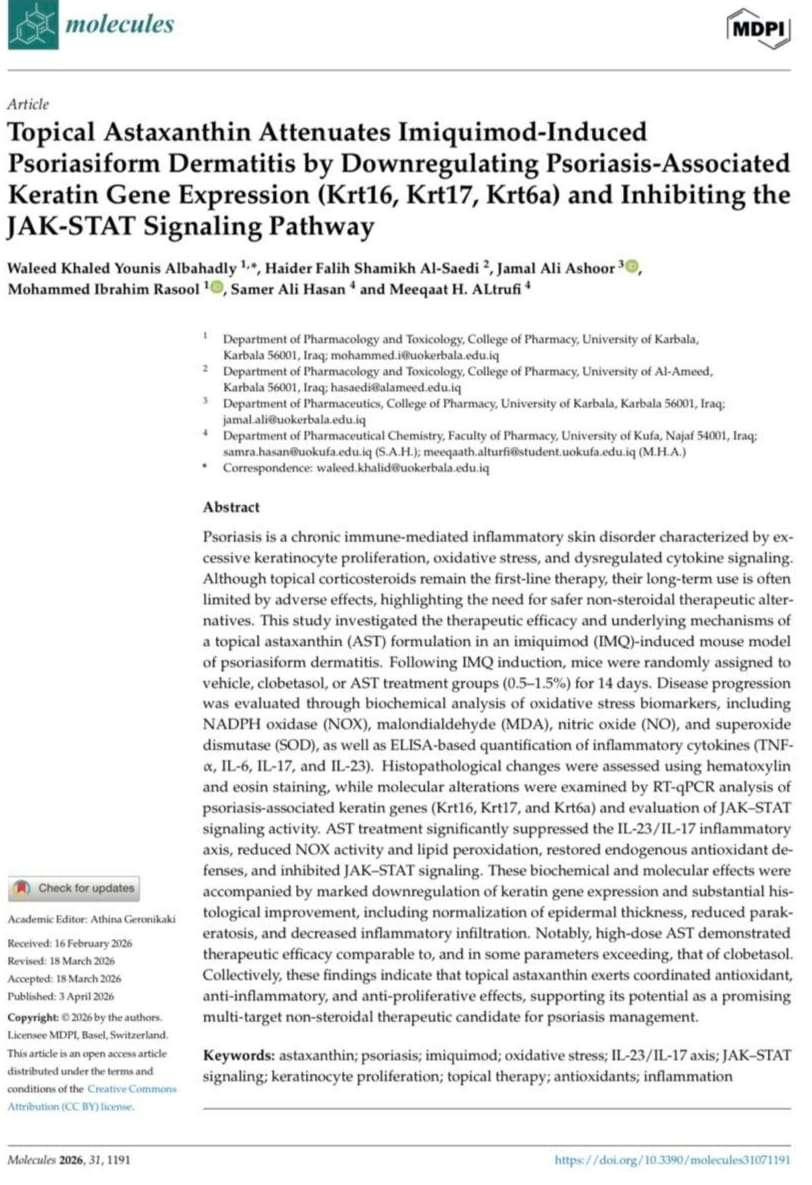
The study, titled “The Effect of Topical Astaxanthin in Psoriasis: An Experimental Study on the Imiquimod Model,” was published in the journal Molecules, published by the international publishing house MDPI.
This publication is part of the University of Karbala’s efforts to enhance its research presence in reputable international journals. Molecules is a peer-reviewed scientific journal indexed in prestigious international databases, including Scopus and Web of Science. It is ranked in the top quartile (Q1) in several scientific disciplines, with an Impact Factor of approximately 4.6 and a CiteScore of approximately 6.5, reflecting a high level of scientific quality.
The research was conducted by:
Assistant Professor Dr. Mohammed Ibrahim Rasoul
Assistant Professor Dr. Jamal Ali Ashour
Assistant Lecturer Waleed Khalid Younis
The study aimed to evaluate the efficacy of topical astaxanthin as a potential treatment option for psoriasis, based on the experimentally used imiquimod model to simulate the disease.
The research analyzed the biological effects of astaxanthin across several axes, including reducing inflammation, lowering oxidative stress, and regulating molecular pathways associated with the disease, particularly the JAK-STAT pathway, as well as its effect on gene expression related to skin cell proliferation.
The results showed that astaxanthin possesses a clear ability to reduce inflammatory cytokines, including IL-17, IL-23, TNF-α, and IL-6, in addition to reducing markers of oxidative stress, enhancing antioxidant activity, improving skin histological changes, and reducing epidermal thickness.
This research is an important scientific addition in the field of dermatology and biotherapy, and it opens up future prospects for the development of safe and effective topical treatments that could represent a non-steroidal alternative in the treatment of psoriasis.